Place Value Worksheets
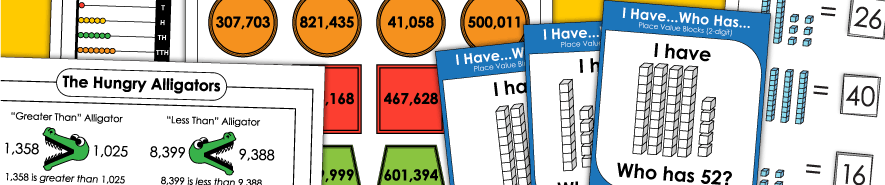
This page offers a large collection of place value worksheets with 2-digit numbers. Skills include finding the value of the underlined digit, expanded form, comparing numbers, ordering, and reading numbers.
(Approx. level: Kindergarten - 1st)
This page has a set of 3-digit PV worksheets and games. Skills covered include: digit values, standard/expanded form, reading and writing numbers, ordering, comparing, and place value blocks.
(Approx. level: 1st and 2nd Grades)
Browse our massive collection of 4-digit place value activities. Includes a variety of games and printables, covering: expanded notation, inserting commas, reading numbers, place value blocks, digit values, and more.
(Approx. level: 2nd and 3rd Grades)
The printables on this page can be used for teaching and reviewing 5-digit place value. Practice finding the values of the underlines digits, write numbers in expanded notation, arranging numbers from least to greatest, and placing commas correctly.
(Approx. level: 3rd and 4th Grades)
Practice place value up to hundred-thousands with these games and worksheets. Learn about digit values, writing number names, expanded and standard notation, and comparing large numbers.
(Approx. level: 3rd and 4th Grades)
These PV activities have large 7-digit numbers, up to 9,999,999. This page has a variety of worksheets, games, cut-and-glue projects, and lesson ideas.
(Approx. level: 4th through 6th Grades)
Print worksheets, cut-and-glue activities, and other activities for learning about place value up to 10 digits (billions).
Decimal Place Value: TenthsReview place value skills to the nearest tenth. Includes comparing, ordering, and finding the value of the underlined digit.
Place Value: HundredthsThese worksheets will help kids learn about reading, ordering, comparing, and values of digits in numbers to the nearest hundredth.
Place Value: ThousandthsDetermine the values of digits to the nearest thousandths place. Also, review ordering, rounding, and comparing numbers to the nearest thousandth place.
Place Value: MoneyPractice place value with money amounts. Read money amounts; compare and order money. Round to the nearest penny, dime, or dollar.
Math WorksheetsAccess all genres of math worksheets on STW including the 4 main operations of adding, subtracting, multiplying, and dividing, plus many subtopics on this full math index page.
Rounding WorksheetsRounding to the nearest ten, hundred, and/or thousand.
100 and 120 ChartsDownload a variety of different 100 charts and 120 charts.
Numbers and Counting (Up to 30)This index page will link you to worksheets on counting up to 10, counting up to 20, and counting up to 30. Also includes specific number trace-and-print activities for 1 through 30.
Special Number WorksheetsLearn about place value with these "special number" worksheets. Available in 1-digit, 2-digit, 3-digit, 4-digit, and 5-digit numbers.
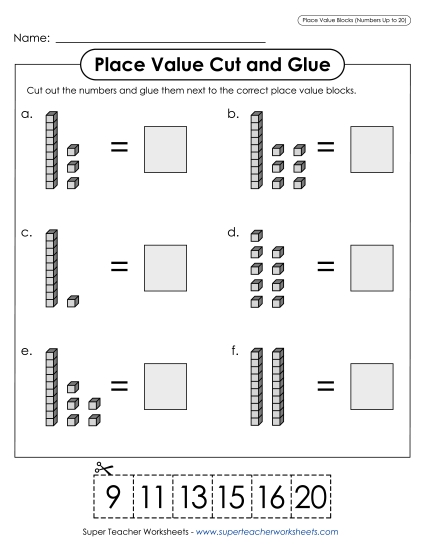
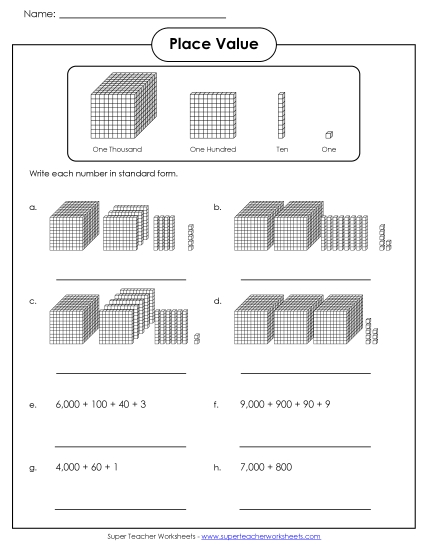
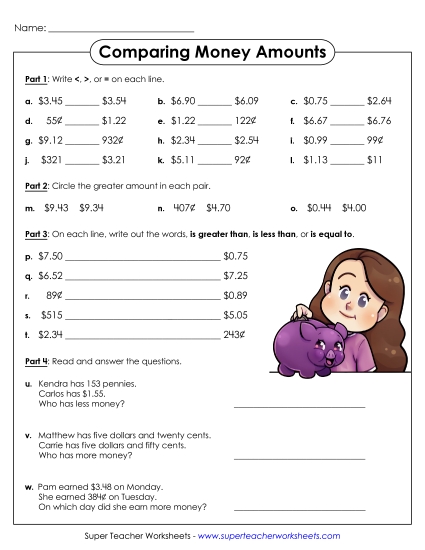
Place value is a key concept in elementary school math, providing students with a deeper understanding of the number system and how numbers are structured. Usually introduced in first grade and reinforced throughout second and third grades, place value teaches children that the position of a digit in a number determines its value. For instance, in the number 324, the digit "3" represents three hundred because of its position in the hundreds place. This understanding helps students make sense of larger numbers, paving the way for skills such as addition, subtraction, multiplication, and division with multi-digit numbers.
In the classroom, teachers use a variety of strategies to help students grasp place value. Visual aids like place value charts, base ten blocks, and manipulatives help children physically see how numbers are grouped into ones, tens, hundreds, and beyond. Number lines and expanded notation exercises further solidify the concept by breaking numbers down into their individual place values. Hands-on activities, such as building numbers with manipulatives or using digital apps that visualize place value, make the learning process engaging and interactive. These methods are essential in ensuring that students not only memorize place value but truly understand how it works within the broader number system.
Understanding place value is crucial for students' mathematical development because it forms the foundation for virtually all future math concepts. Without a solid grasp of place value, students may struggle with operations involving large numbers, decimals, and fractions. Mastery of place value also enhances mental math abilities, helping students quickly estimate and compute answers in their heads. Additionally, place value is a vital skill in everyday life, from calculating sums of money to measuring quantities. By building a strong foundation in place value, teachers help students achieve greater success in both their academic and practical mathematical endeavors. Super Teacher Worksheets offers a plethora of material to teach young learners all about place value!
Principles of Place Value
TABLE OF CONTENTS
- What Is Place Value and Why It Matters
- How Place Value Works
- Place Value Whole Number Example
- Place Value with Decimals
- Common Place Value Misconceptions and Sudent Mistakes
- Visual Models for Teaching Place Value
- Teaching Place Value by Grade Level
- Printable Place Value Worksheets & Activities
- Interactive Online Place Value Practice
- Place Value Practice Problems
- Frequently Asked Questions About Place Value
- Place Value Term Glossary
- Place Value Summary: Standards Alignment & Author Credentials
What Is Place Value and Why It Matters
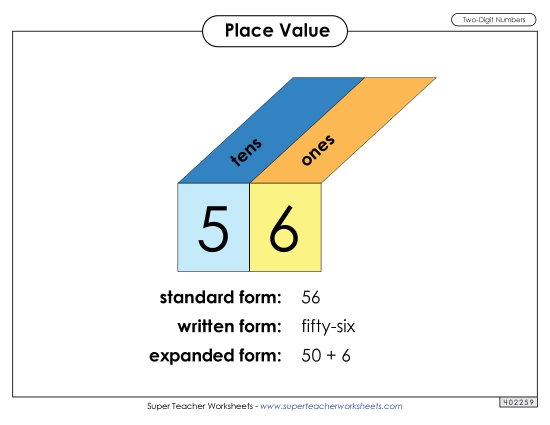
Place value is the system we use to determine the value of each digit in a number based on its position. For example, in the number 432, the 3 is in the tens place, so it represents 30. This concept is often taught using a place value chart to help elementary students visualize how numbers are built.
In 5,428 the digit "4" represents 400 (i.e. 4 hundreds).
Place value is the value a digit has based on its position in a number. Place value helps us read, write, compare, and understand numbers of all sizes. Below you'll find clear explanations, examples, and printable worksheets for grades K–8.
Understanding place value is essential because it helps students:
- Build strong number sense
- Read and write large numbers
- Compare and order numbers correctly
- Add and subtract using regrouping
- Understand decimals and fractions
- Break apart numbers using expanded form and word form
- Add and subtract multi-digit numbers correctly
How Place Value Works
- Write the number and label each digit's place (e.g. thousands, hundreds, tens, ones).
- Multiply each digit by the value of its place.
- Add up those values to get the number in standard form (though this is just restating the number).
Place Value Whole Number Example
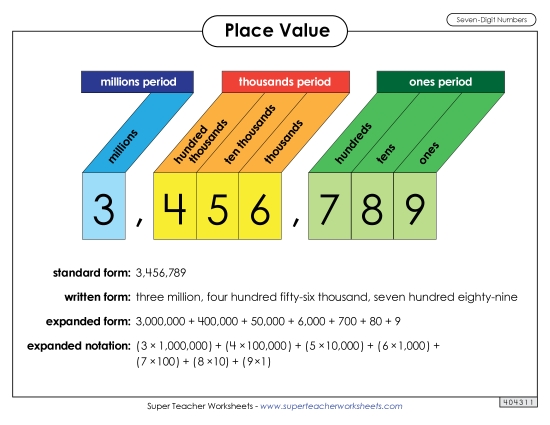
Whole numbers include zero and all positive integers. As numbers get larger, the place value of each digit added to the left is 10 times greater than the place value of the digit to its right. This also means that the place value of each digit to the right is 10 times smaller than (or 1/10 the size of) the digit to its left.
Millions | Hundred Thousands | Ten Thousands | Thousands | Hundreds | Tens | Ones
5 Digits / Ten Thousands Place Value Example
Consider the number 12,345:
- The 1 is in the ten thousands place. 1 × 10,000 = 10,000
- The 2 is in the thousands place. 2 × 1,000 = 2,000
- The 3 is in the hundreds place. 3 × 100 = 300
- The 4 is in the tens place. 4 × 10 = 40
- The 5 is in the ones place. 5 × 1 = 5
Written in expanded form: 10,000 + 2,000 + 300 + 40 + 5
Place Value With Decimals
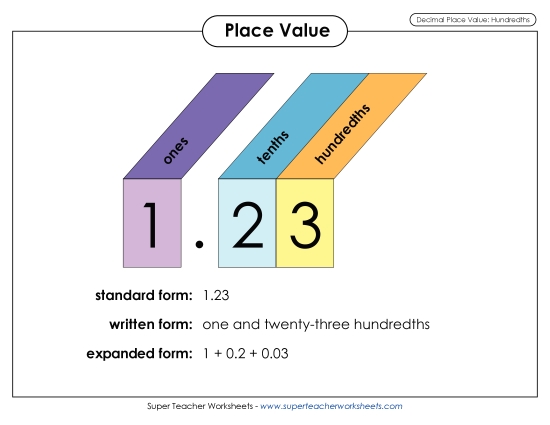
Decimals represent fractions of a whole. A decimal point is inserted to the right of the ones place. As with whole number place values, each digit’s value is 10 times smaller than (or 1/10 the size of) the digit to its left and 10 times greater than the digit to its right.
Ones | Tenths | Hundredths | Thousandths
- The tenths place represents 1/10
- The hundredths place represents 1/100
- The thousandths place represents 1/1000
3 Decimal Points / Thousandths Place Value Example
Consider the number 1.234:- The 1 is in the ones place. 1 × 1 = 1
- The 2 is in the tenths place. 2 × 1/10 = 2/10 or 0.2
- The 3 is in the hundredths place. 3 × 1/100 = 3/100 or 0.03
- The 4 is in the thousandths place. 4 × 1/1,000 = 4/1,000 or 0.004
- Written in expanded form: 1 + 2/10 + 2/100 + 4/1,000 or 1 + 0.2 + 0.03 + 0.004
Common Place Value Misconceptions & Mistakes Students Make
Here are a few misunderstandings and potential pitfalls students often fall into with place value:
- confusing the digit with the value of the digit, i.e. forgetting that digits must be multiplied by their place value (e.g. in the number 456, thinking the digit 4 represents the value 4 rather than 4 × 100, or 400)
- forgetting that zero is a placeholder (e.g. interpreting the number 507 as 57, forgetting that the 0 represents 0 tens)
- writing digits left to right without recognizing place value (e.g. hearing the number 507 orally and recording it as 5,007 because the number 500 contains two zeroes)
- misaligning place value during addition and subtraction (e.g. aligning whole numbers on the left with different place values rather than on the right by the ones place)
- confusing the relative values of decimal places (e.g. mistakenly believing hundredths are larger than tenths since 100 is greater than 10, therefore thinking the number 0.02 is greater than 0.2)
- believing additional zeroes to the right impact decimal values (e.g. thinking 0.600 is greater than 0.6 because it has more digits)
- mixing up expanded notation with expanded form (expanded notation goes a step further than expanded form by showing the digit and place values as factors in parentheses, e.g. the number 456 in expanded notation is (4 × 100) + (5 × 10) + (6 × 1) and in expanded form is 400 + 50 + 6)
To help students avoid mistakes and confusion, it is important to use visual models such as base-10 blocks or place value charts. It also helps to have students verbalize the value of each digit as they write numbers to reinforce the concept and prevent skipping placeholder zeroes.
Visual Models for Teaching Place Value
Base-Ten Blocks
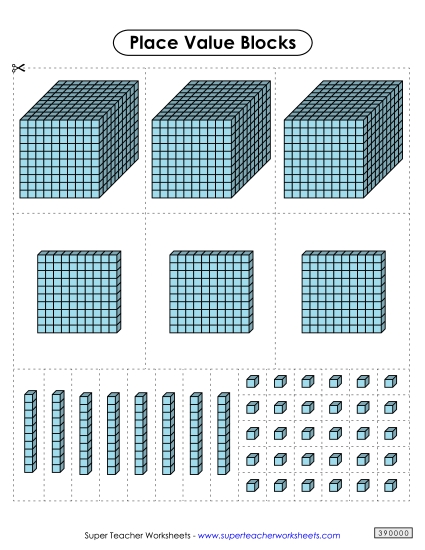
These blocks help students see and touch place value. They're excellent for teaching regrouping (carrying/borrowing) and engaging tactile learners.
- small cubes = ones
- rods = tens
- flats = hundreds
- large cubes = thousands
Place Value Disks
Place value disks or chips are color-coded circles labeled by place (ones, tens, hundreds, etc.). As an alternative to base-10 blocks, they're great for:
- comparing numbers
- building multi-digit numbers
- demonstrating regrouping
Place Value Charts
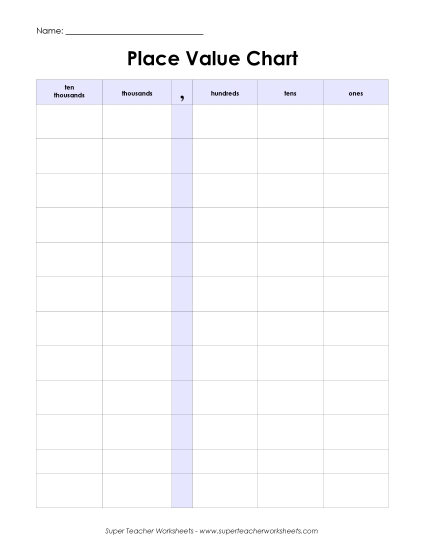
Place value anchor charts are important references while students learn place value concepts. However, there are also many blank place value chart activities students can do to reinforce their understanding, including:
- build numbers from verbal descriptions
- compare large or decimal numbers
- convert numbers to expanded form
- slide digits left or right to multiply/divide by 10
Teaching Place Value by Grade Level
Place value concepts are essential to math instruction. Certain place values and place value skills are explicitly taught in early grades and later built upon.
Kindergarten and 1st Grade- tens and ones
- counting by tens
- comparing 1- and 2-digit numbers
- properly aligning numbers to add and subtract (within 100)
- beginning number sense
- hundreds and thousands
- counting by fives, tens, and hundreds
- comparing multi-digit numbers
- properly aligning numbers to add and subtract (within 1,000)
- rounding to the nearest ten or hundred
- standard, word, and expanded form
- place value up to millions
- decimal place value (tenths, hundredths, thousandths))
- comparing decimals
- rounding to decimals and all other place values
- properly aligning multi-digit numbers to multiply and divide, including decimals
- multiplying and dividing by powers of 10
- using exponents to denote powers of 10
Although place value is not taught directly in upper grades, core place value concepts are still implicitly used in more advanced math skills such as comparing rational numbers.
Printable Place Value Worksheets & Activities
We offer a variety of printables to reinforce place value skills at various stages of learning. The links below will take you to worksheet sets for just some of our place value resources.
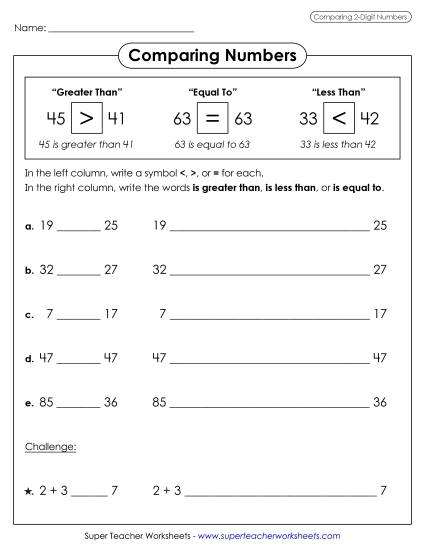
- 2-Digit Place Value Worksheets - ones and tens; includes base-10 block interpretations, identifying greater or less than, ordering sets of numbers,
- 3-Digit Place Value Worksheets - thousandths; includes decimal expanded form, a classroom game, and a mixed sort with multiple decimal place values
- 4-Digit Place Value Worksheets - thousands; includes place value sorting cards, comparing values in word problems, and practice reading numbers accurately
- 6-Digit Place Value Worksheets - hundred thousands; includes matching standard and word forms of numbers, place value task cards, and a wheel for reading numbers
- Large Number Place Value (to billions) - up to billions; includes a place value cut-and-paste activity, expanded form practice, and identifying digit values
- Place Value in Money Worksheets - includes ordering money, reading monetary values practice, and comparing prices word problems
All worksheets include an answer key when applicable, and many include hands-on cut-and-paste or matching activities to make learning interactive.
Interactive Online Place Value Practice
iKnowIt.com provides elementary-level practice lessons to help learn and master place value. These interactive place value activities include an array of question formats, fun character interactions, and student rewards to keep students engaged.
Here are just a few samples of the many place value lessons we offer
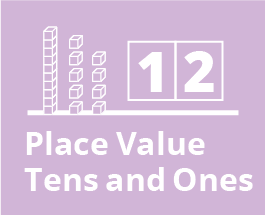
- 1st Grade Place Value: Tens and Ones - This is an online practice game that will help students learn place value using tens and ones. Students will practice place value up to 100.
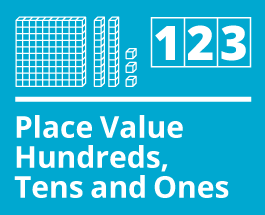
- 1st Grade Place: Hundreds, Tens, and Ones - Try this first grade-level math lesson to practice place value with hundreds, tens, and ones with your class today!
- 2nd Grade Place Value: Numbers up to 99 - This interactive 2nd grade math lesson covers place value working with numbers up to ninety-nine.
- 2nd Grade Place Value: Numbers up to 999 - Get place value practice at the second grade level in this fun online activity that uses examples on numbers up to 999.
- 2nd Grade Place Value: Numbers up to 9,999 - This online practice game will help 2nd grade students learn place value to the thousands. Students will practice with base ten blocks, expanded and word forms.
- 3rd Grade Place Value: Up to a Million - Try out this 3rd grade math lesson for digit values covering numbers all the way up to 999,999.
Place Value Practice Problems
Identify a digit's value
What is the value of the underlined digit? 48,902
Answer: 6,000
Explanation: Since there is no decimal, we can begin identifying place values starting with the 2 as the ones place and working our way left. The digit 8 is in the thousands place. So, multiply 8 × 1,000 to get the total value of the digit: 8,000)
Recognize place values
Which digit is in the ones place? 23.16
Answer: 3
Explanation: Decimal points always appear to the right of the ones place. The decimal point in this number appears to the right of the digit 3, therefore we know the digit 3 is in the ones place.
Write a number in a different form
Write the number 11,075 in expanded form.
Answer: 10,000 + 1,000 + 70 + 5
Explanation: Expanded form expresses numbers as a sum of their digits’ values. Since there is no decimal point, we know that the digit 5 is in the ones place. The other digits’ place values increase while moving left. Multiply the digits by their respective place values (1 × 10,000, 1 × 1,000, 0 × 100, 7 × 10, and 5 × 1), then express the products as a sum. Note: the hundreds place becomes a placeholder 0 and adds no additional information, so it can be dropped from the final sum.
Write a number in a different form
Write the number fifty-six and three hundredths in standard form.
Answer: 56.03
Explanation: Standard form is the most common form, expressing numbers using numerals. Fifty-six is expressed as 56. The word and in written form indicates a decimal. The place value hundredths indicates the fractional part is out of 100 and goes to the second place value past the decimal point, expressed as 0.03. Combine the components to arrive at the final standard form: 56.03
Order sets of numbers
Order the numbers from least to greatest. 9.651 | 9.564 | 9.609 | 9.059
Answer: 9.059 | 9.564 | 9.609 | 9.651
Explanation: When comparing numbers, begin by identifying the largest digit in the greatest place value in your set. Since the numbers in this set all share a 9 in the ones place, we must move right to the next greatest place value, the tenths place. Here the digits are different: 9.059 has a 0, indicating it is our least value; 9.564 has a 5, indicating it is greater than 9.059, but less than the remaining two numbers, which both have a 6 in the tenths place. For those remaining two numbers, we must move to the next place value again: the hundredths place. The 0 in 9.609 is less than the 5 in 9.651, so we know it is the next in the sequence. That leaves 9.651 as the greatest number.
Frequently Asked Questions About Place Value
What grade is place value usually taught?
Place value concepts typically begin in kindergarten and 1st grade (with ones and tens), and extend through 5th grade for very large number place values, decimal place values, and exponents to denote powers of ten. Place value is often not taught directly in upper grades, but the principles are still used.
How can I help students who confuse place value with counting?
Always start with 2- and 3-digit numbers before moving to larger ones. Use base-10 manipulatives (blocks, rods, units) and have them verbally state each digit’s value (e.g. “4 thousands, 2 hundreds”). Ready access to labeled place value anchor charts is also helpful.
What are the differences between number writing forms?
Standard form is the most typical way numbers are expressed. It is written with numerals, e.g. 2,434.
Word form or written form uses full words to express a number, e.g. two thousand four hundred thirty-four. It is important to remember “and” is only used for decimals and commas are not used.
Expanded form expresses numbers as a sum of each digit’s value, e.g. 2,000 + 400 + 30 + 4. Any placeholder 0 digit should be excluded from the sum.
Expanded notation further emphasizes how place value works by expressing numbers as the sum of the products of each digit and its respective place value, e.g. (2 × 1,000) + (4 × 100) + (3 × 10) + (4 × 1). Any placeholder 0 digit should be excluded from the sum.
Expanded notation further emphasizes how place value works by expressing numbers as the sum of the products of each digit and its respective place value, e.g. (2 × 1,000) + (4 × 100) + (3 × 10) + (4 × 1). Any placeholder 0 digit should be excluded from the sum.
Place Value Term Glossary
The following are some common terms and concepts related to place value that all students should understand.
- digit - a single numeral (0–9) used to make numbers
- value of a digit - the total worth of a digit based on its position
- ones place - the position showing how many groups of one are in a number
- tens place - the position showing how many groups of ten are in a number
- hundreds place - the position showing how many groups of one hundred are in a number
- thousands place - the position showing how many groups of one thousand are in a number
- ten thousands / hundred thousands / millions place - larger place value positions showing how many groups of their respective values are in a number
- tenths / hundredths / thousandths – the decimal place values representing groups of fractional parts (1/10, 1/100, 1/1000)
- decimal point - the dot separating whole numbers from fractional parts, positioned to the right of the ones place
- expanded form - a number written as the sum of each digit’s value (e.g., 300 + 40 + 5)
- expanded notation - a number written as the sum of the products of each digit and its place value (e.g., (3 × 100) + (4 × 10) + (5 × 1))
- standard form - the most common way to write a number (e.g., 345).
- word form - writing a number in words (e.g., three hundred forty-five).
- base-ten system - our number system, which is based on groups of ten
- comparing numbers - looking at the place value of digits to determine whether numbers are greater than, less than, or equal to one other
- regrouping - rearranging numbers between different place values when adding or subtracting (also called borrowing or carrying)
- rounding - simplifying a number into a more convenient value, always done to a specified place value (e.g. 492 rounded to the nearest 10 is 490, but rounded to the nearest 100 is 500)
Place Value Summary
Place value is about understanding how a digit's position gives it a specific value (ones, tens, hundreds, etc.). By combining clear explanations, worked examples, and downloadable worksheets, this page aims to support teachers, parents, and students. Use the links above to find level-appropriate practice and deepen understanding step by step. These place value learning materials have been created by elementary teachers and accredited educators and aligned to current curriculum / Common Core math standards.