What's New on STW
We add new printable worksheets, games, and teaching tools all the time! This page highlights some of our most recent additions to the site.
1,476 new files added over the past 365 days.

(added October 26, 2026)
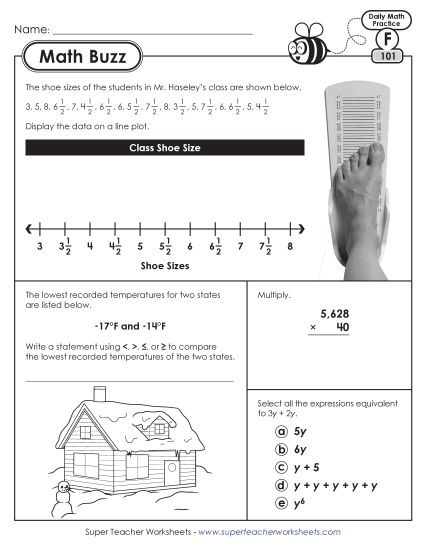
Combine like terms, analyze data in a histogram, convert units of measure, and much more with this week's set of daily math review worksheets.


Filing Cabinet
Logged in members can use the Super Teacher Worksheets filing cabinet to save their favorite worksheets.
Quickly access your most used files AND your custom generated worksheets!
Please login to your account or become a member and join our community today to utilize this helpful feature.

(added October 26, 2026)
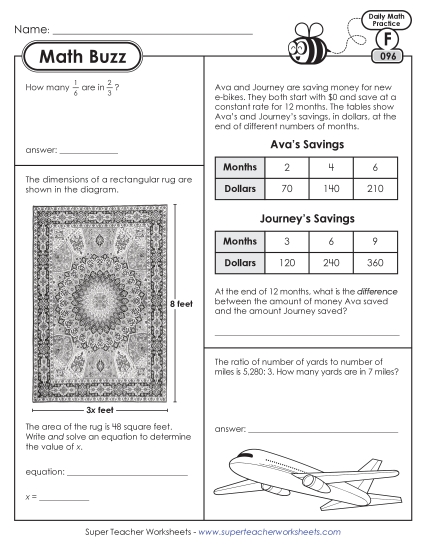
This week, students will create histograms, calculate volume, explore ratios, and much more.
(added October 26, 2026)
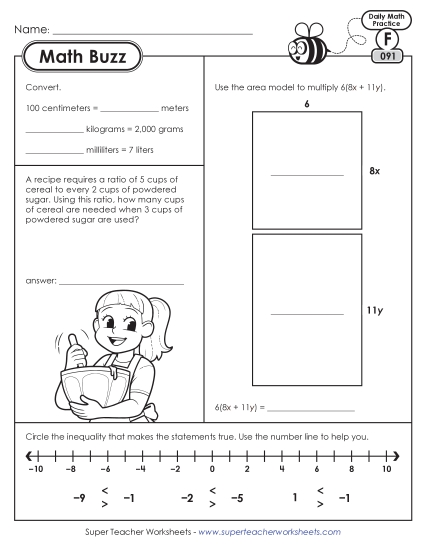
Help your students practice key math skills every day with these daily review worksheets covering skills like inequalities, area models, ratios, and much more.
(added October 22, 2026)
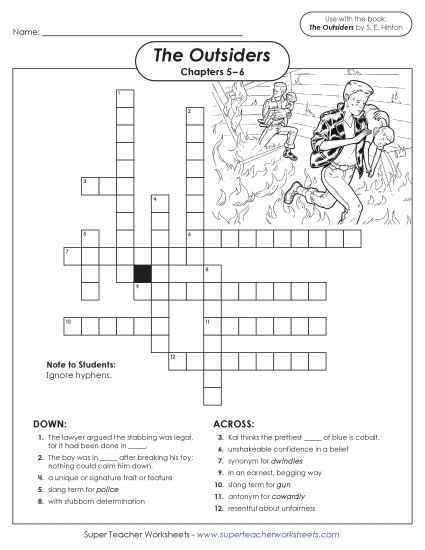
Use the vocabulary terms from chapters 5 and 6 to complete this crossword puzzle. Clues and an optional word bank are included.


(added October 22, 2026)
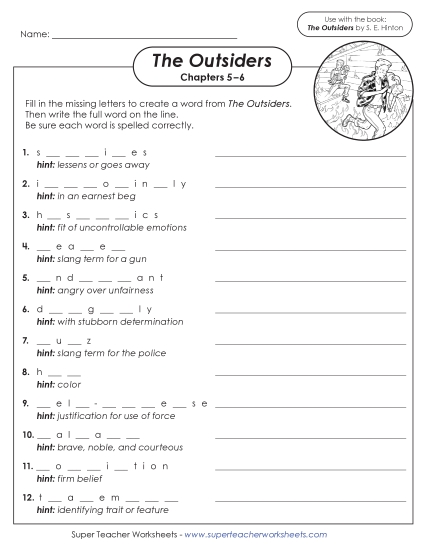
Fill in the missing letters to complete each of the vocabulary words from this part of the novel. Then write the full word on the line. Hints are given.
(added October 22, 2026)
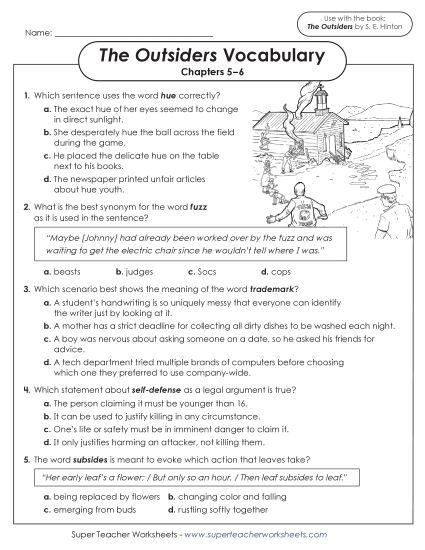
Confirm your understanding of the vocab words from this section by correctly answering the questions in this printout.
(added October 22, 2026)
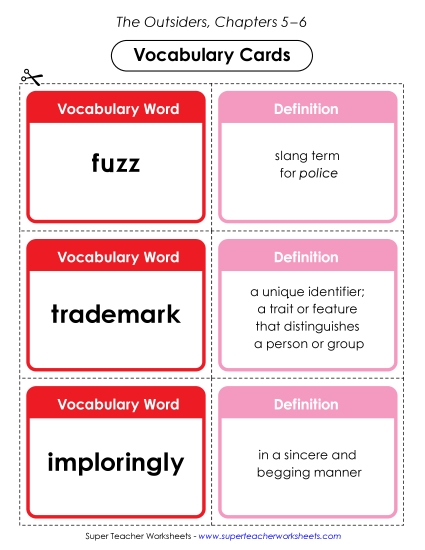
The vocabulary words for this section of the book are fuzz, trademark, imploringly, gallant, hue, subsides, indignant, heater, self-defense, doggedly, conviction, and hysterics. Use these flashcards to help students practice the words and their definitions.
(added October 22, 2026)
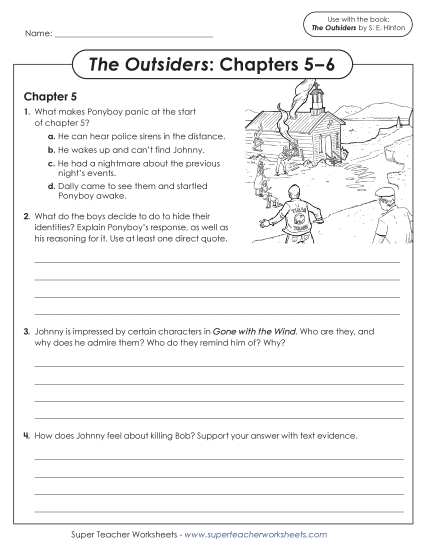
Review important aspects of chapters 5 and 6 of The Outsiders with this question packet. Questions include both short answer and multiple choice responses.
(added October 22, 2026)
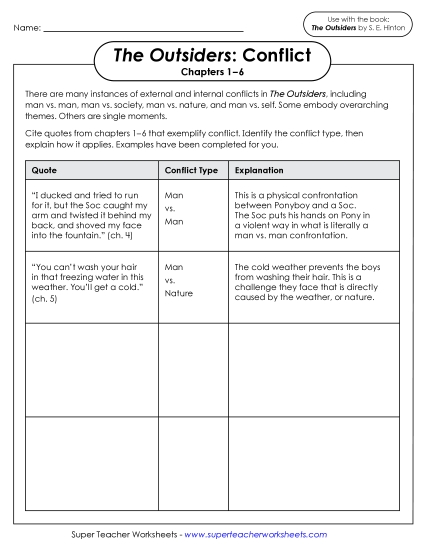
Use quotes from chapters 1 through 6 of The Outsiders to identify and explain instances of different conflict types.
(added October 22, 2026)
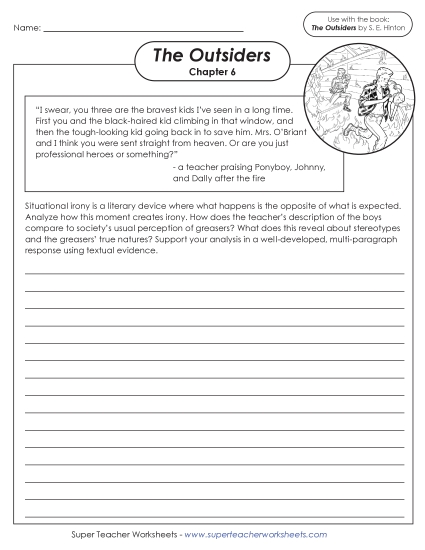
Use this writing prompt to help students understand situational irony as it is created by the moment when Ponyboy, Johnny, and Dally are praised by a teacher after the fire in chapter 6.

Have you seen the Super Teacher Blog? We post fun, new teaching ideas every month.
Be sure to check it out. Go To STW's Blog
(added October 22, 2026)
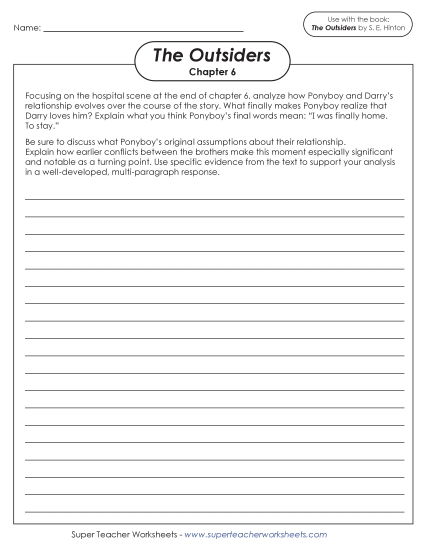
Focusing on the hospital scene at the end of chapter 6, analyze how Ponyboy and Darry's relationship evolves over the course of the story. Explain what finally makes Ponyboy realize Darry loves him and what his words at the end of the chapter mean.
(added October 22, 2026)
In chapter 5, Ponyboy recites Robert Frost's poem "Nothing Gold Can Stay." With this prompt, students will write about its overall meaning and connection to the themes of the novel so far.
(added October 22, 2026)
Use evidence from the text to write about Dally's actions in regard to taking risks to visit and help Ponyboy and Johnny in chapters 5 and 6.
(added October 22, 2026)
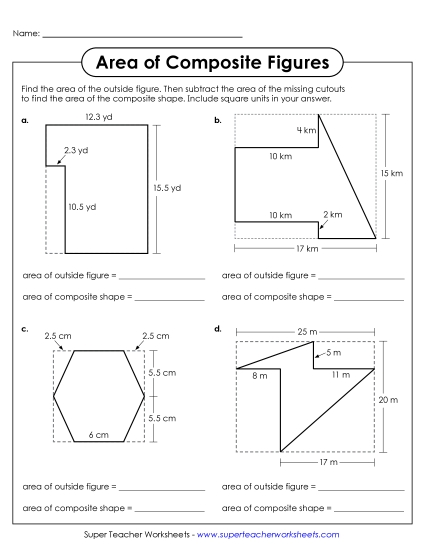
Subtract the areas of the missing shapes from the areas of the outside figures to find the areas of the composite shapes on this worksheet.
(added October 22, 2026)
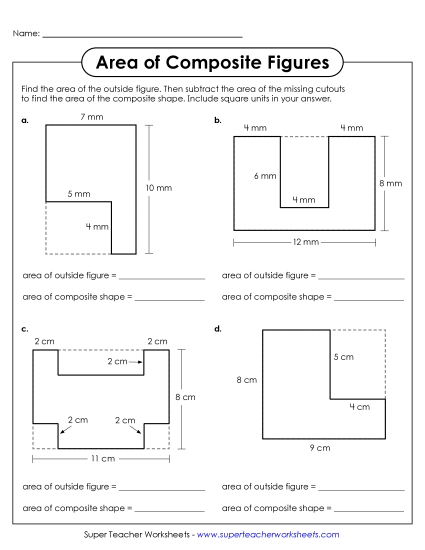
With this worksheet, students will find the areas of figures by subtracting the areas of missing parts or cutouts.
(added October 22, 2026)
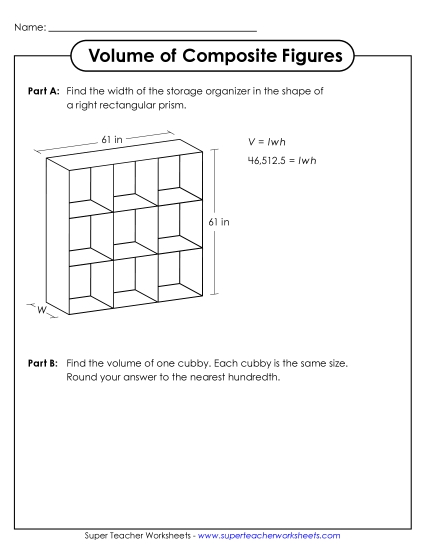
With this worksheet, students will find the missing width of a storage organizer, as well as the volume of one of the cubbies within the organizer.
(added October 21, 2026)
This writing prompt encourages students to write a journal entry from Esperanza's perspective about her birthday celebration, using details from chapter 14 and earlier in the book on how this celebration was different from her last birthday.
(added October 20, 2026)
In chapter 13, Esperanza becomes upset with how they are being treated in California and asks Miguel, "Is this the better life that you left Mexico for?" She goes on to say, "Nothing is right here!" Explain why she feels this way and how Miguel feels.
(added October 20, 2026)
Use your understanding of the novel so far to help answer the questions in this packet. Questions include multiple choice and short answer.
(added October 20, 2026)
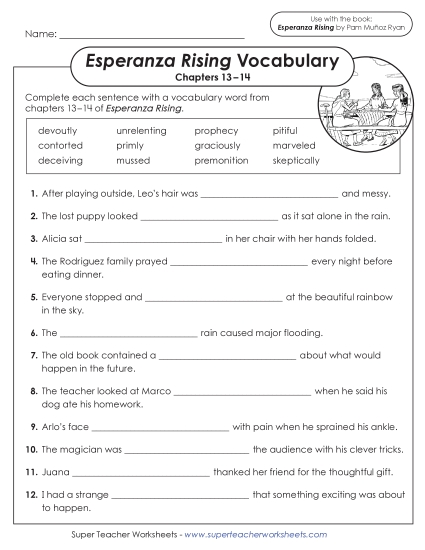
This fill-in-the-blank activity features a word bank with key vocabulary terms from chapters 13 and 14 of Esperanza Rising. Correctly complete the sentences by choosing the best term to use in each sentence.
(added October 20, 2026)
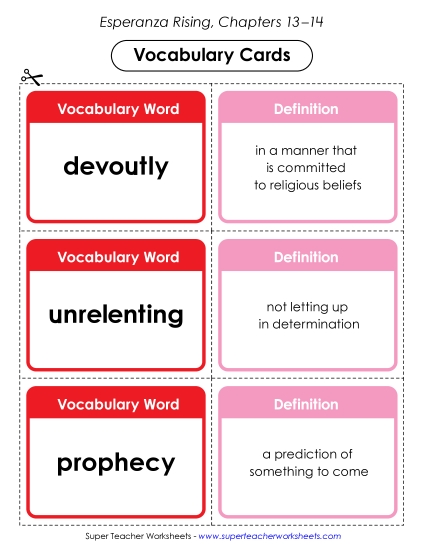
Use these cards to help make sure your students understand the vocabulary terms from chapters 13 and 14: devoutly, unrelenting, prophecy, pitiful, contorted, primly, graciously, marveled, deceiving, mussed, premonition, and skeptically.
(added October 20, 2026)
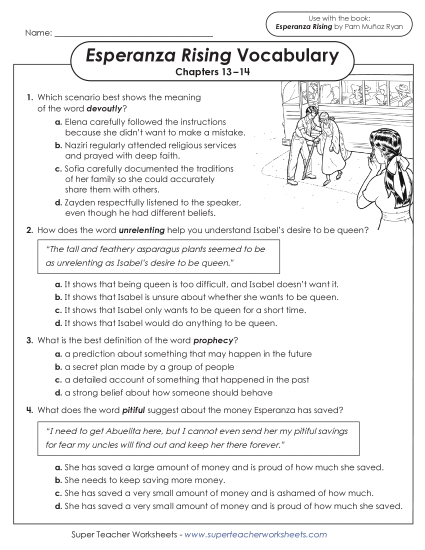
Test your students' understanding of vocabulary terms by having them answer questions about important words from chapters 13 and 14 of Esperanza Rising.
¿Habla español?
Many of our worksheets have been translated into Spanish! Click the button below worksheet descriptions to view our Spanish translations. Learn more.
Many of our worksheets have been translated into Spanish! Click the
button below worksheet descriptions to view our Spanish translations. Learn more.(added October 20, 2026)
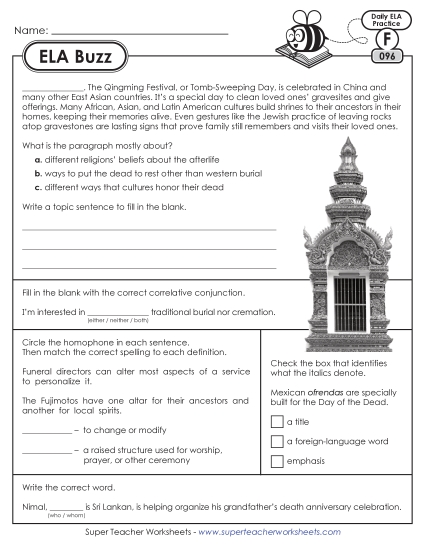
Practice grammar, vocabulary, spelling, and other language arts skills daily with our 6th grade ELA Buzz worksheets.
(added October 20, 2026)
Solve 6th grade math problems involving number lines, coordinate grids, price distribution, and much more with this week's Math Buzz worksheets.
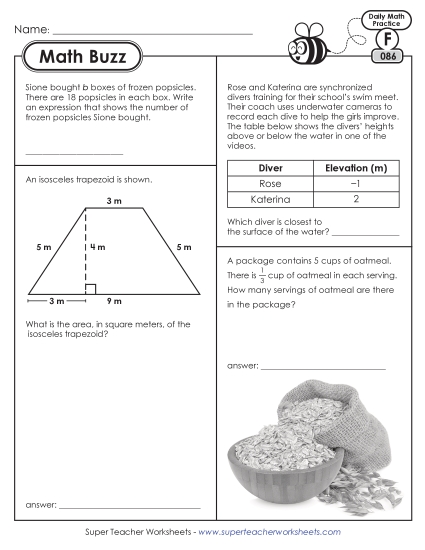
(added October 20, 2026)
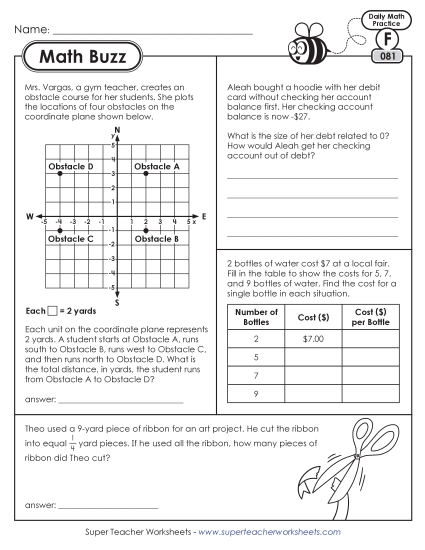
This week with 6th grade Math Buzz, students will practice calculating distance on a coordinate plane, finding area of parts of shapes, answering word problems, and much more.
(added October 15, 2026)
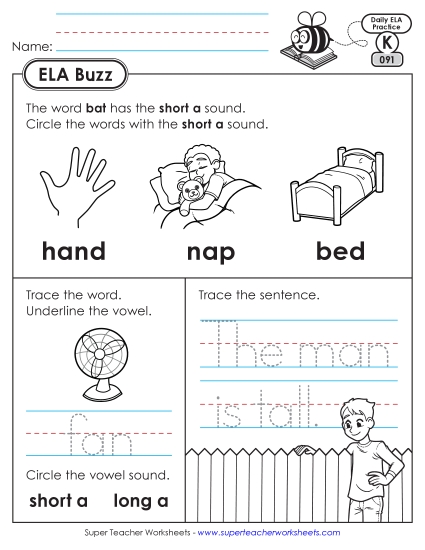
Practice short vowel sounds, tracing words and full sentences, identifying beginning letters of words, and much more with this week's Kindergarten ELA Buzz.
(added October 15, 2026)
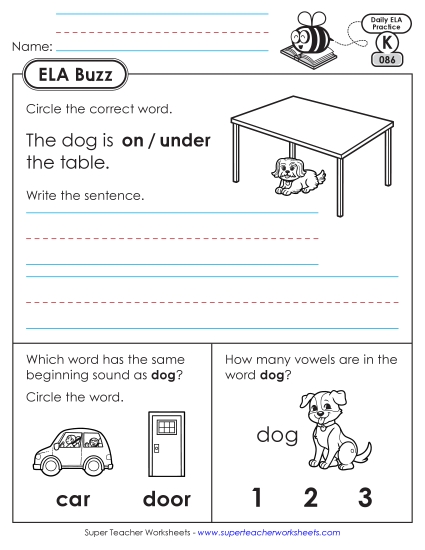
Review important kindergarten ELA concepts including phonics sounds, CVC words, and basic position words.
(added October 15, 2026)
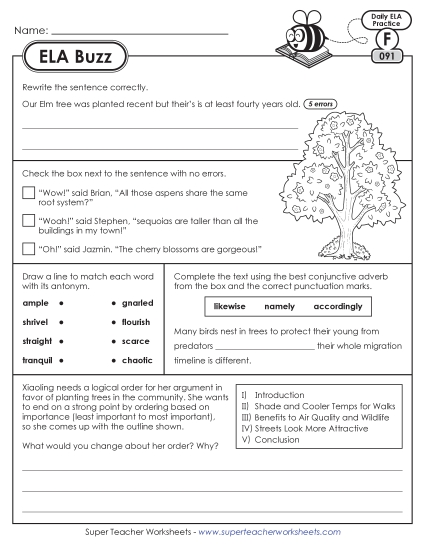
Continue refining 6th grade language arts skills with our daily ELA Buzz worksheets. This week's assignments include proofreading, matching antonyms, logically ordering points in an argument, and much more!
(added October 15, 2026)
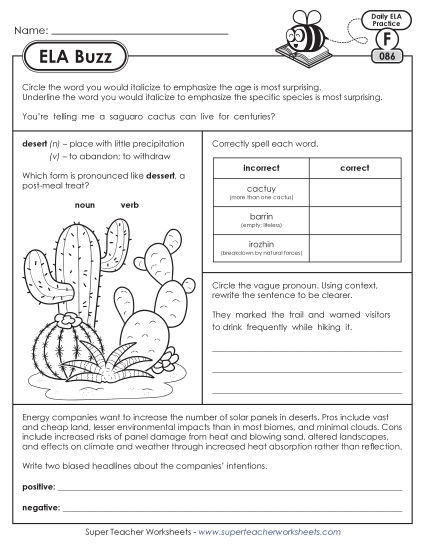
Fix misspelled words, use context to choose correctly spelled homophones, identify errors in clarity, and more with this week's daily ELA review sheets.
(added October 15, 2026)
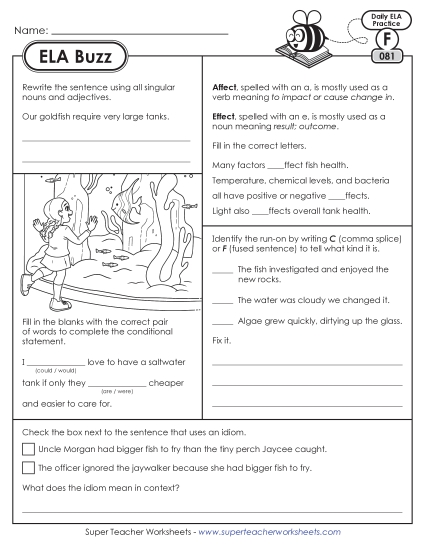
This week's ELA Buzz worksheets include questions about conditional statements, run-on sentences, paraphrasing, and much more.
(added October 8, 2026)
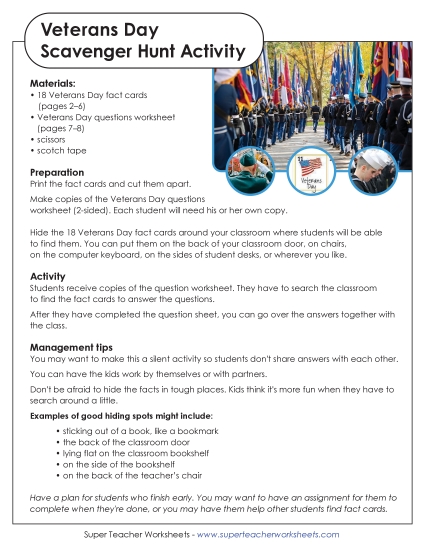
Help your students learn interesting and important facts about Veterans Day with an engaging scavenger hunt activity.
(added October 8, 2026)
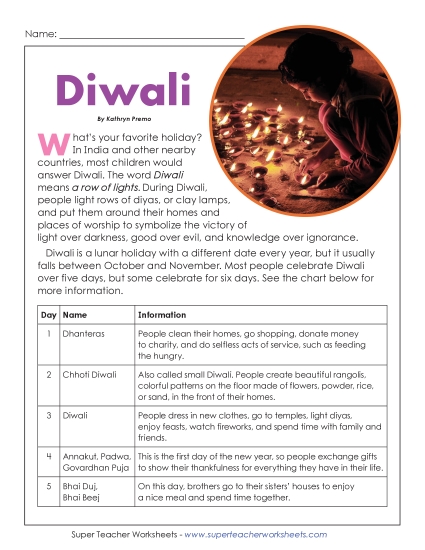
Written for more advanced readers or to be used as a guided classroom activity, this article gives details about Diwali and its celebrations as well as the story behind the holiday.
(added October 8, 2026)
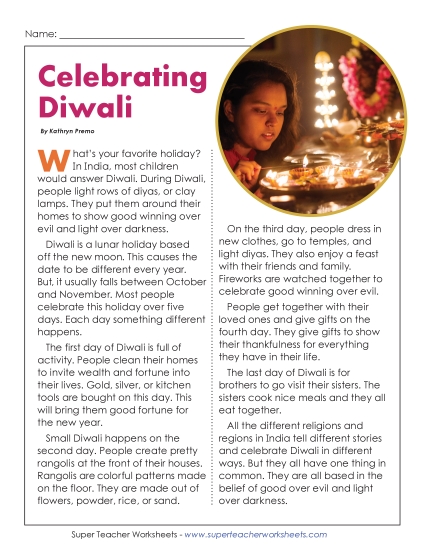
Teach students the basics of Diwali with this nonfiction passage. For those at a 4th grade or higher reading level, it makes great independent work. For those at lower levels, you may wish to read the article as a group and have them answer the questions either independently or together.
(added October 8, 2026)
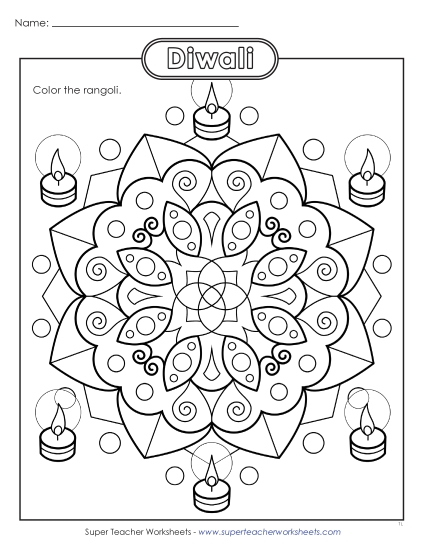
If your students enjoy coloring in rangolis, here is another Diwali-themed coloring page with one!
(added October 8, 2026)
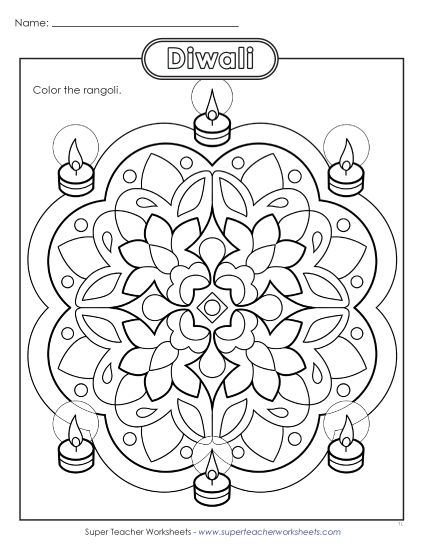
This rangoli coloring page features diyas around an intricate design.
(added October 8, 2026)
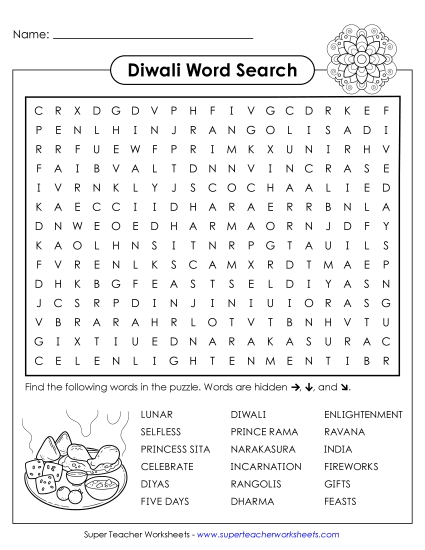
This Diwali word search is a bit harder than our easy version. It features longer and more advanced terms such as Princess Sita, Prince Rama, enlightenment, incarnation, and Narakasura.
(added October 8, 2026)
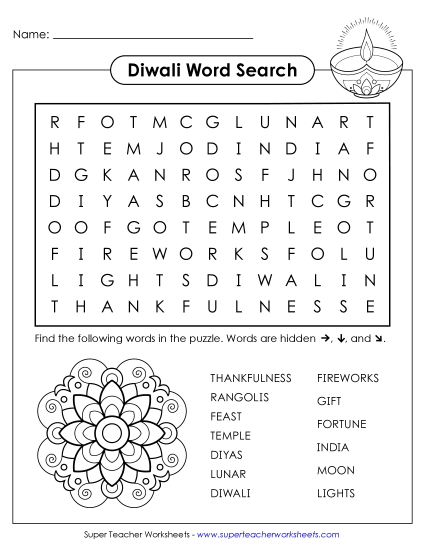
Look for words like thankfulness, rangolis, lunar, moon, and more in this Diwali-themed word search.
(added October 8, 2026)
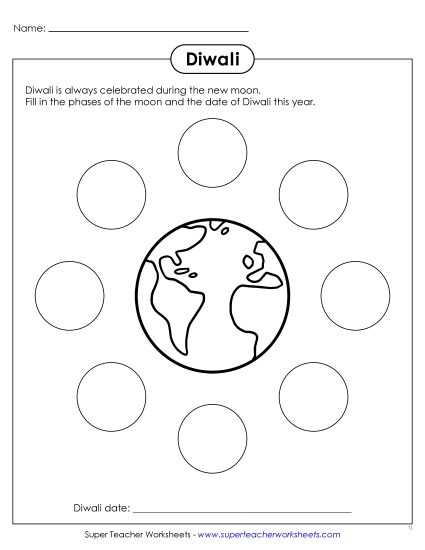
Diwali's date is based on the phases of the moon. It always happens during the new moon. With this worksheet, students will fill in the different phases of the moon and write the date that Diwali falls on this year.
(added October 8, 2026)
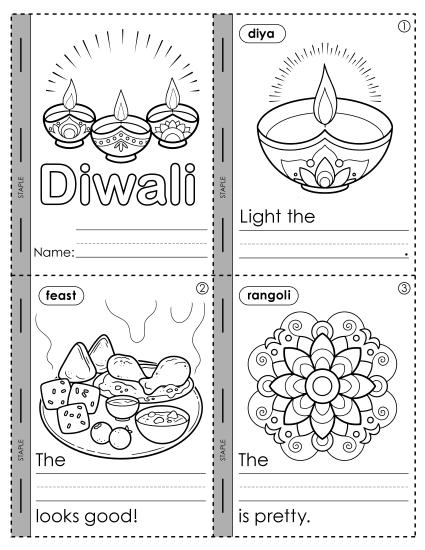
Students can color the pictures, write the vocabulary words to complete the sentences, and cut out and attach the pages to create their very own Diwali mini book.
(added October 8, 2026)
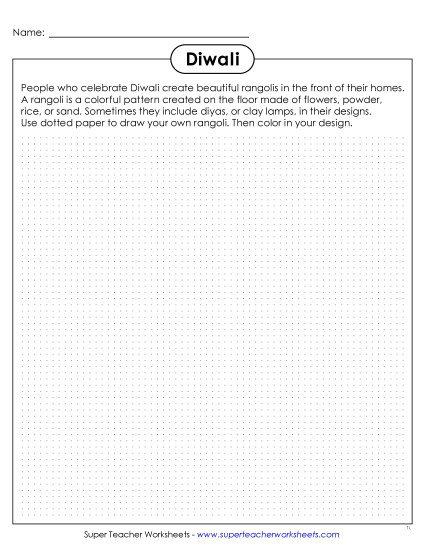
This worksheet gives students a brief description of what a rangoli is and instructs them to design their own. With a dotted grid, students can easily include flowers, diyas, or other design elements in their rangoli.
(added October 8, 2026)
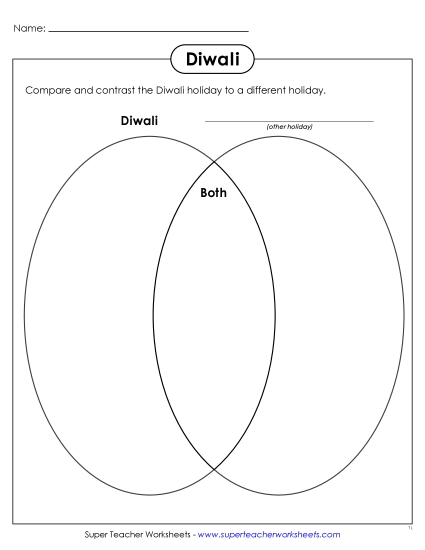
Use this Venn diagram to compare and contrast Diwali to another holiday, noting both similarities and differences.
(added October 8, 2026)
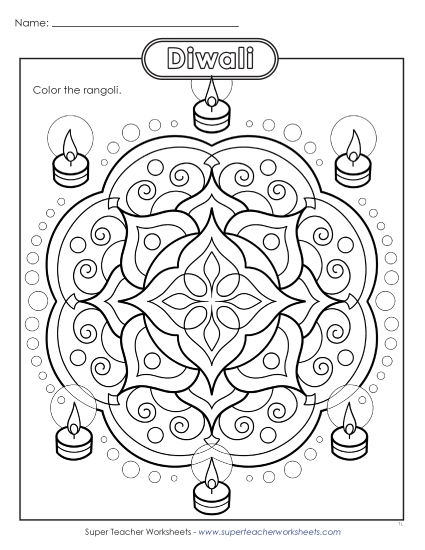
Use your favorite shades to color in this intricate rangoli design.
(added October 8, 2026)
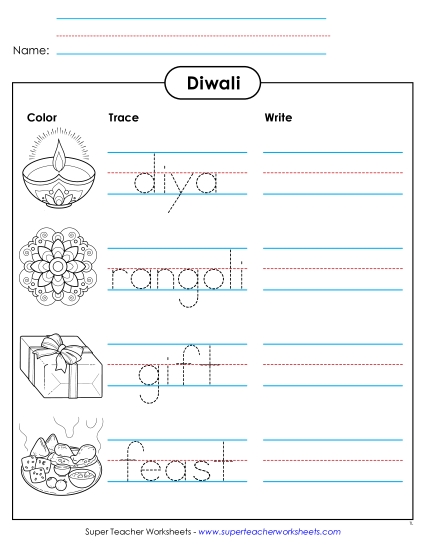
Teach your students how the words diya, rangoli, gift, and feast relate to Diwali, and have them practice tracing and writing the words on this worksheet.
(added October 8, 2026)
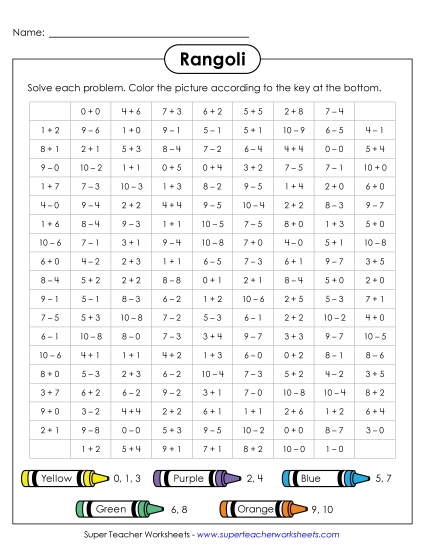
Add or subtract to find solutions to all of the problems on the page. Then color according to the key to create a beautiful rangoli.
(added October 8, 2026)
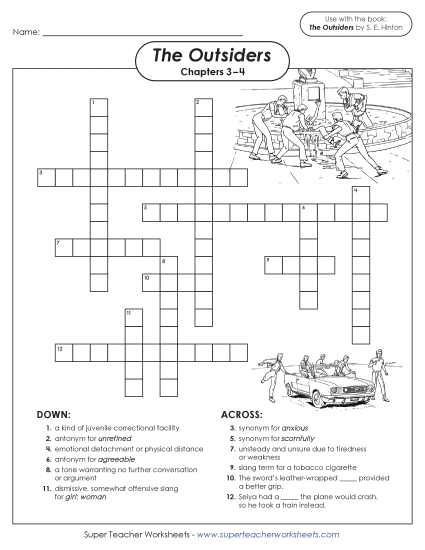
Test your students' knowledge and understanding of the vocabulary terms from this section with a fun crossword puzzle activity.
(added October 8, 2026)
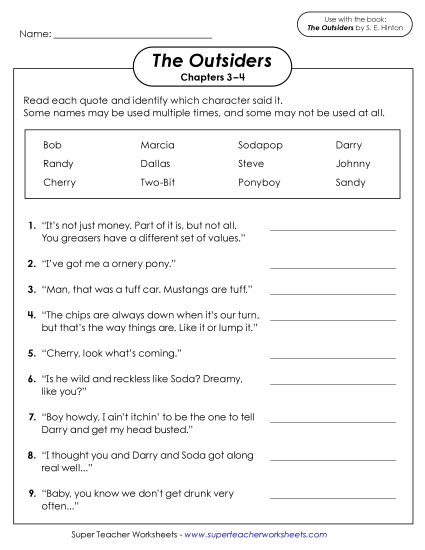
Read the quotes from chapters 3 and 4 and identify which character said them.
(added October 8, 2026)
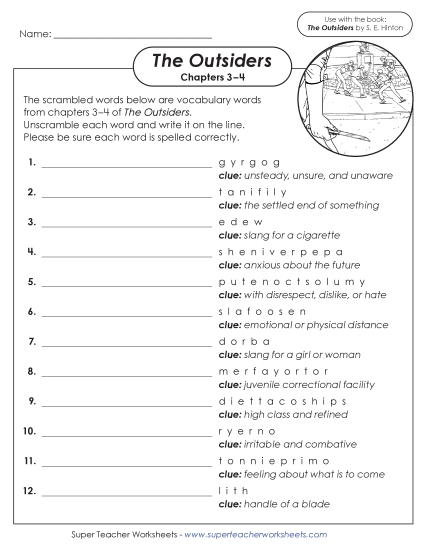
Make sure your students understand the vocabulary words for chapters 3 and 4 of The Outsiders with this word scramble activity.
(added October 8, 2026)
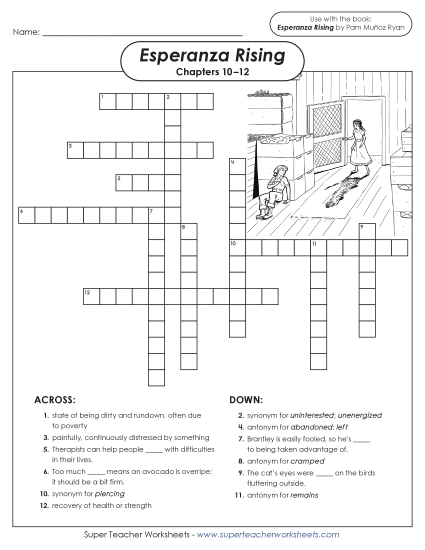
Use the clues to complete this crossword puzzle with words from chapters 10 through 12 of the novel. Terms include tormented, riveted, recuperation, cavernous, and more.
(added October 7, 2026)
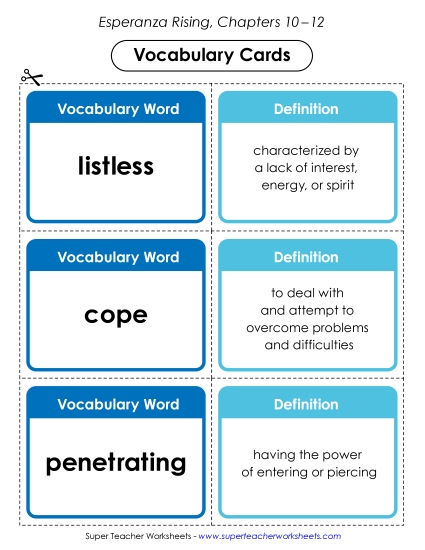
Practice the vocabulary words and definitions for this section of Esperanza Rising with these cards. The following words are included: listless, cope, penetrating, cavernous, riveted, suppleness, susceptible, tormented, squalor, recuperation, accompanied, and remnants.
(added October 7, 2026)
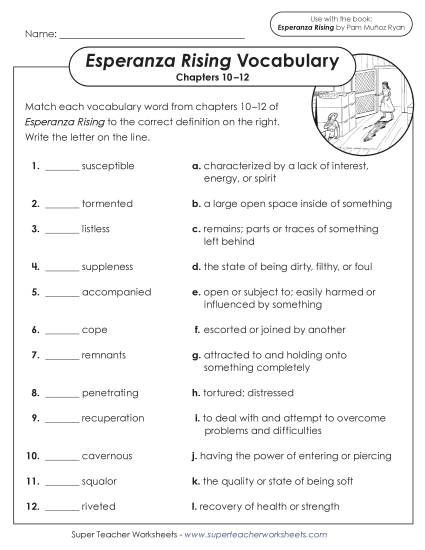
Match the vocabulary words from this section of the novel to their correct definitions by writing the corresponding letters on the lines.