Primary and Secondary Sources
Teach your students how to determine whether a resource is a primary or secondary source with these worksheets. Printable PDFs also cover evaluating the reliability of different sources.

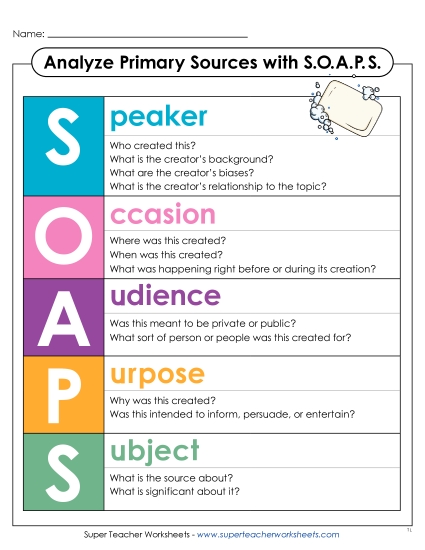
This anchor chart breaks down the acronym SOAPS, which stands for Speaker, Occasion, Audience, Purpose, Subject. For each word, the chart shows several questions that can be useful to ask when analyzing primary sources.
4th and 5th Grades

Filing Cabinet
Logged in members can use the Super Teacher Worksheets filing cabinet to save their favorite worksheets.
Quickly access your most used files AND your custom generated worksheets!
Please login to your account or become a member and join our community today to utilize this helpful feature.

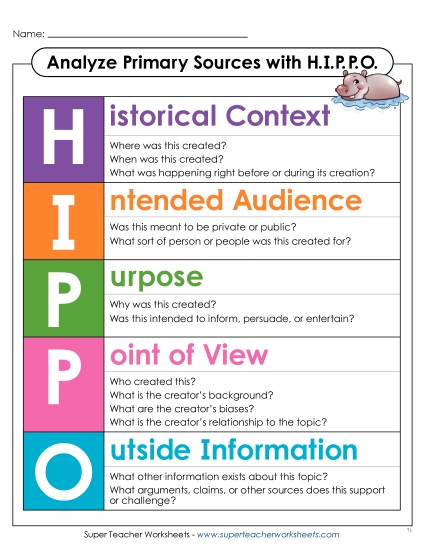
The acronym HIPPO can be a helpful way to remember what to consider when analyzing primary sources. It stands for Historical Context, Intended Audience, Purpose, Point of View, and Outside Information. This anchor chart shows questions that should be asked with each part of the acronym.
4th and 5th Grades
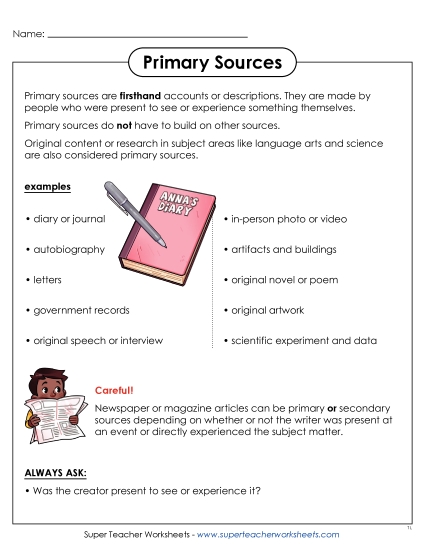
This anchor chart includes a definition and examples of primary sources. It also reminds the reader to ask if the creator was present to see or experience the event to determine if a source is primary.
4th and 5th Grades
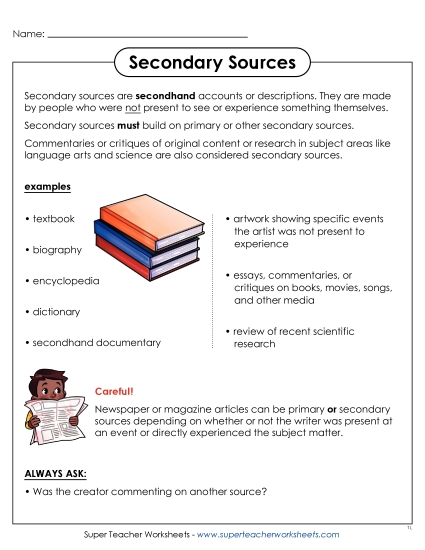
This anchor chart has helpful information about secondary sources, including explanations, examples, and the tip to always ask if the creator is commenting on another source.
4th and 5th Grades
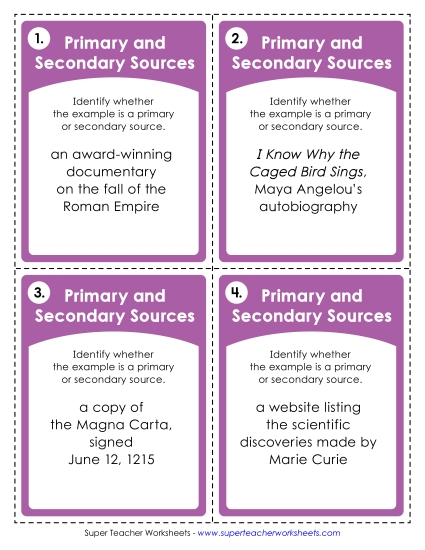
Each of these 30 task cards require students to determine whether a specific source is primary or secondary. Our task cards can be used in centers, as exit slips, or for a variety of games and activities.
4th through 6th Grades

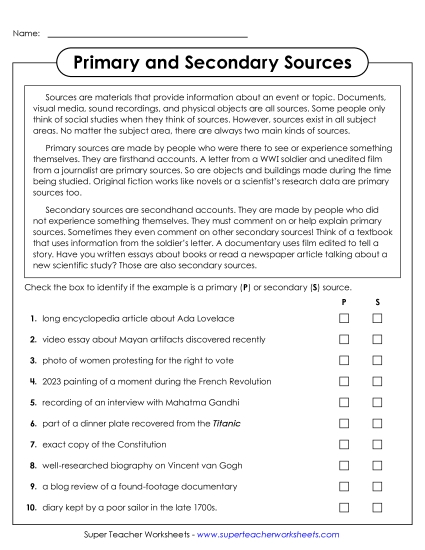
This worksheet includes a detailed explanation for students to read about primary and secondary sources. After reading the text, they will determine whether 10 examples of sources are primary or secondary.
4th and 5th Grades
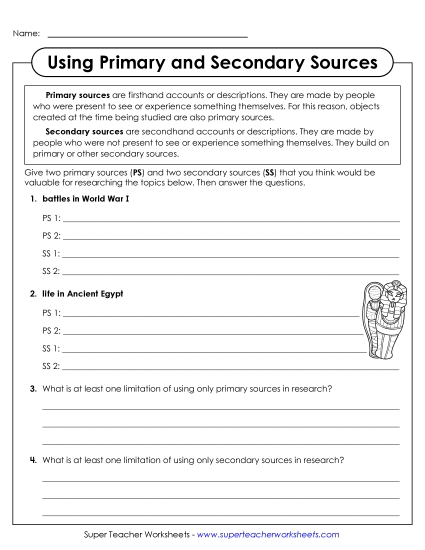
This printable worksheet gives definitions for both primary and secondary sources. It then asks students to give examples of useful primary and secondary sources for specific topics. Students will also discuss the limitations of each type of source.
4th and 5th Grades
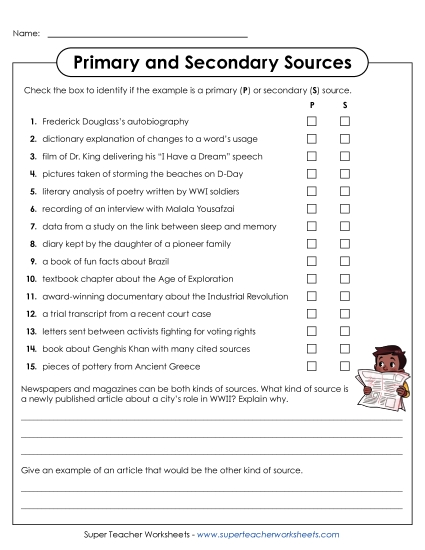
This worksheet lists 15 specific examples of sources. Students must determine and identify whether each source is primary or secondary.
4th and 5th Grades
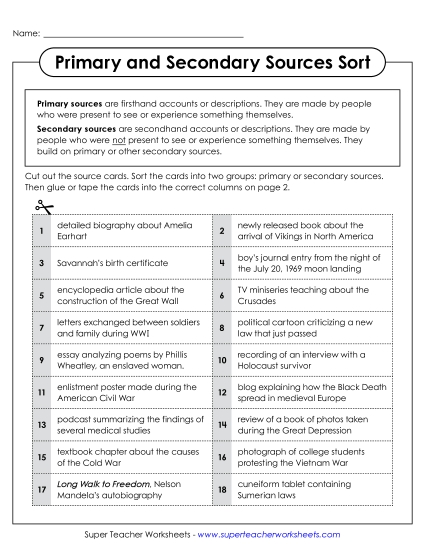
Cut out the 18 source cards. Read them and sort into two groups: primary or secondary sources. Then glue or tape them each into the correct column on the t-chart.
4th and 5th Grades
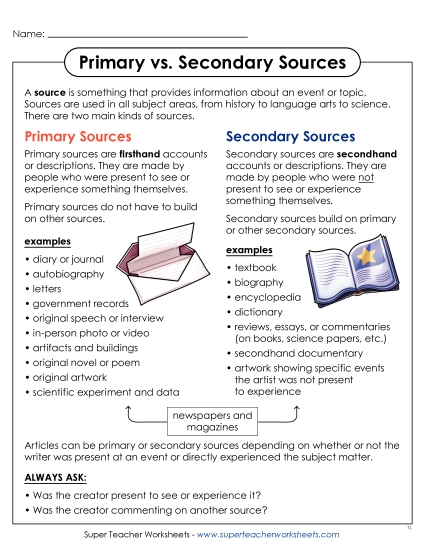
This printable anchor chart is perfect for reminding students of the differences between primary and secondary sources. It includes examples of each type of source, definitions, and questions to ask to determine which type of source something is.
4th and 5th Grades
Check out our full collection of social studies worksheets here.
ELA IndexOur ELA collection includes articles and biographies that make excellent examples of secondary sources, as well as resources to help students practice writing essays where they may need to use these sources.