L.4.4c:
Language
Vocabulary Acquisition and Use
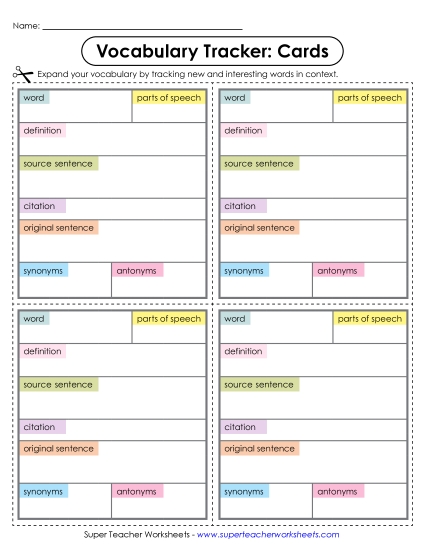
Consult reference materials (e.g., dictionaries, glossaries, thesauruses), both print and digital, to find the pronunciation and determine or clarify the precise meaning of key words and phrases.
L.4.5c:
Language
Vocabulary Acquisition and Use
Demonstrate understanding of words by relating them to their opposites (antonyms) and to words with similar but not identical meanings (synonyms).
L.4.6:
Language
Vocabulary Acquisition and Use
Acquire and use accurately grade-appropriate general academic and domain-specific words and phrases, including those that signal precise actions, emotions, or states of being (e.g., quizzed, whined, stammered) and that are basic to a particular topic (e.g., wildlife, conservation, and endangered when discussing animal preservation).
L.5.4c:
Language
Vocabulary acquisition and Use
Consult reference materials (e.g., dictionaries, glossaries, thesauruses), both print and digital, to find the pronunciation and determine or clarify the precise meaning of key words and phrases.
L.5.5c:
Language
Vocabulary acquisition and Use
Use the relationship between particular words (e.g., synonyms, antonyms, homographs) to better understand each of the words.
L.5.6:
Language
Vocabulary acquisition and Use
Acquire and use accurately grade-appropriate general academic and domain-specific words and phrases, including those that signal contrast, addition, and other logical relationships (e.g., however, although, nevertheless, similarly, moreover, in addition).
L.6.4c:
Language
Vocabulary Acquisition and Use
Consult reference materials (e.g., dictionaries, glossaries, thesauruses), both print and digital, to find the pronunciation of a word or determine or clarify its precise meaning or its part of speech.
L.6.4d:
Language
Vocabulary Acquisition and Use
Verify the preliminary determination of the meaning of a word or phrase (e.g., by checking the inferred meaning in context or in a dictionary).
L.6.5b:
Language
Vocabulary Acquisition and Use
Use the relationship between particular words (e.g., cause/effect, part/whole, item/category) to better understand each of the words.
L.6.6:
Language
Vocabulary Acquisition and Use
Acquire and use accurately grade-appropriate general academic and domain-specific words and phrases; gather vocabulary knowledge when considering a word or phrase important to comprehension or expression.
L.7.4c:
Language
Vocabulary Acquisition and Use
Consult general and specialized reference materials (e.g., dictionaries, glossaries, thesauruses), both print and digital, to find the pronunciation of a word or determine or clarify its precise meaning or its part of speech.
L.7.4d:
Language
Vocabulary Acquisition and Use
Verify the preliminary determination of the meaning of a word or phrase (e.g., by checking the inferred meaning in context or in a dictionary).
L.7.5b:
Language
Vocabulary Acquisition and Use
Use the relationship between particular words (e.g., synonym/antonym, analogy) to better understand each of the words.
L.7.6:
Language
Vocabulary Acquisition and Use
Acquire and use accurately grade-appropriate general academic and domain-specific words and phrases; gather vocabulary knowledge when considering a word or phrase important to comprehension or expression.
L.8.4c:
Language
Vocabulary Acquisition and Use
Consult general and specialized reference materials (e.g., dictionaries, glossaries, thesauruses), both print and digital, to find the pronunciation of a word or determine or clarify its precise meaning or its part of speech.
L.8.4d:
Language
Vocabulary Acquisition and Use
Verify the preliminary determination of the meaning of a word or phrase (e.g., by checking the inferred meaning in context or in a dictionary).
L.8.5b:
Language
Vocabulary Acquisition and Use
Use the relationship between particular words to better understand each of the words.
L.8.6:
Language
Vocabulary Acquisition and Use
Acquire and use accurately grade-appropriate general academic and domain-specific words and phrases; gather vocabulary knowledge when considering a word or phrase important to comprehension or expression.
L.4.4b:
Language
Vocabulary Acquisition and Use
Use common, grade-appropriate Greek and Latin affixes and roots as clues to the meaning of a word (e.g., telegraph, photograph, autograph).
L.5.4b:
Language
Vocabulary acquisition and Use
Use common, grade-appropriate Greek and Latin affixes and roots as clues to the meaning of a word (e.g., photograph, photosynthesis).
L.6.4b:
Language
Vocabulary Acquisition and Use
Use common, grade-appropriate Greek or Latin affixes and roots as clues to the meaning of a word (e.g., audience, auditory, audible).
L.7.4b:
Language
Vocabulary Acquisition and Use
Use common, grade-appropriate Greek or Latin affixes and roots as clues to the meaning of a word (e.g., belligerent, bellicose, rebel).
L.8.4b:
Language
Vocabulary Acquisition and Use
Use common, grade-appropriate Greek or Latin affixes and roots as clues to the meaning of a word (e.g., precede, recede, secede).

 Back
Back