Math
Reading Comprehension
Reading & Writing
Phonics
Early Literacy
Grammar
Spelling Lists
Science
Social Studies
Holidays
Puzzles & Brain Teasers
Teacher Helpers
Pre-K and Kindergarten
Worksheet Generator
Grade Levels
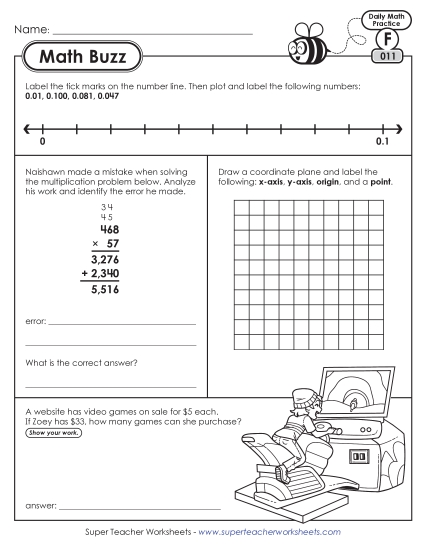
6th Grade Math Buzz Week 8:: Worksheets 36 through 40 Printable Daily Review PDF
This worksheet is recommended for students in Sixth Grade.
- Common Core Standards
5.NBT.45.NBT.75.NBT.64.OA.45.NF.4a5.NF.65.NF.5a5.NF.5b5.OA.36.NS.66.NS.6b6.NS.6a6.EE.16.EE.26.EE.55.MD.5a5.MD.5b6.G.15.MD.25.G.4
 Back
Back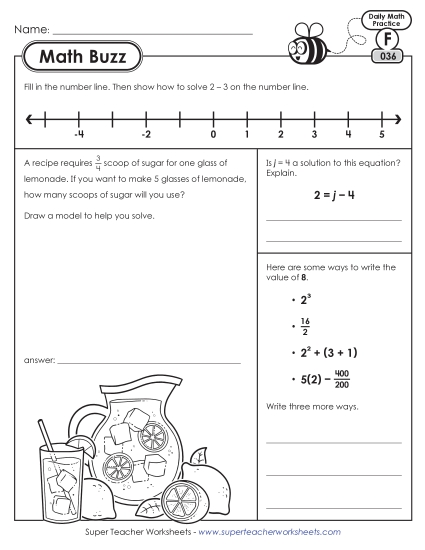

5.NBT.4:
Number And Operations In Base Ten
Understand The Place Value System.
Use place value understanding to round decimals to any place.
5.NBT.7:
Number And Operations In Base Ten
Perform Operations With Multi-Digit Whole Numbers And With Decimals To Hundredths.
Add, subtract, multiply, and divide decimals to hundredths, using concrete models or drawings and strategies based on place value, properties of operations, and/or the relationship between addition and subtraction; relate the strategy to a written method and explain the reasoning used.
5.NBT.6:
Number And Operations In Base Ten
Perform Operations With Multi-Digit Whole Numbers And With Decimals To Hundredths.
Find whole-number quotients of whole numbers with up to four-digit dividends and two-digit divisors, using strategies based on place value, the properties of operations, and/or the relationship between multiplication and division. Illustrate and explain the calculation by using equations, rectangular arrays, and/or area models.
4.OA.4:
Operations And Algebraic Thinking
Gain Familiarity With Factors And Multiples.
Find all factor pairs for a whole number in the range 1-100. Recognize that a whole number is a multiple of each of its factors. Determine whether a given whole number in the range 1-100 is a multiple of a given one-digit number. Determine whether a given whole number in the range 1-100 is prime or composite.
5.NF.4a:
Number And Operations - Fractions
Apply And Extend Previous Understandings Of Multiplication And Division To Multiply And Divide Fractions.
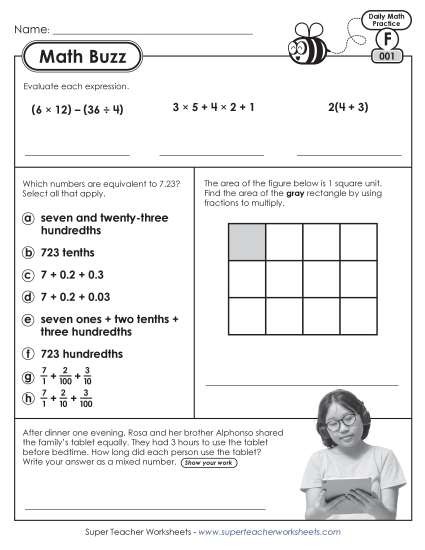
Interpret the product (a/b) x q as a parts of a partition of q into b equal parts; equivalently, as the result of a sequence of operations a x q / b. For example, use a visual fraction model to show (2/3) x 4 = 8/3, and create a story context for this equation. Do the same with (2/3) x (4/5) = 8/15. (In general, (a/b) x (c/d) = ac/bd.)
5.NF.6:
Number And Operations - Fractions
Apply And Extend Previous Understandings Of Multiplication And Division To Multiply And Divide Fractions.
Solve real world problems involving multiplication of fractions and mixed numbers, e.g., by using visual fraction models or equations to represent the problem.
5.NF.5a:
Number And Operations - Fractions
Apply And Extend Previous Understandings Of Multiplication And Division To Multiply And Divide Fractions.
Comparing the size of a product to the size of one factor on the basis of the size of the other factor, without performing the indicated multiplication.
5.NF.5b:
Number And Operations - Fractions
Apply And Extend Previous Understandings Of Multiplication And Division To Multiply And Divide Fractions.
Explaining why multiplying a given number by a fraction greater than 1 results in a product greater than the given number (recognizing multiplication by whole numbers greater than 1 as a familiar case); explaining why multiplying a given number by a fraction less than 1 results in a product smaller than the given number; and relating the principle of fraction equivalence a/b = (n x a)/(n x b) to the effect of multiplying a/b by 1.
5.OA.3:
Operations And Algebraic Thinking
Analyze Patterns And Relationships.
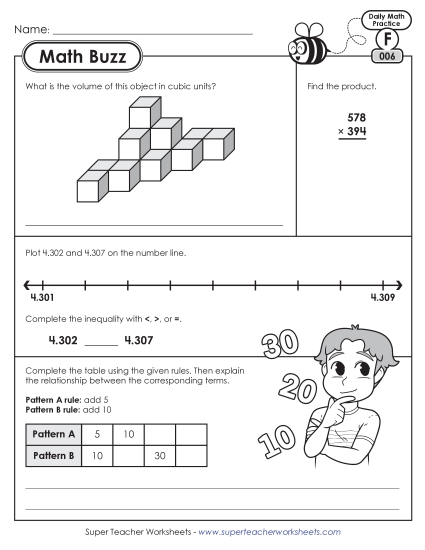
Generate two numerical patterns using two given rules. Identify apparent relationships between corresponding terms. Form ordered pairs consisting of corresponding terms from the two patterns, and graph the ordered pairs on a coordinate plane. For example, given the rule "Add 3" and the starting number 0, and given the rule "Add 6" and the starting number 0, generate terms in the resulting sequences, and observe that the terms in one sequence are twice the corresponding terms in the other sequence. Explain informally why this is so.
6.NS.6:
The Number System
Apply And Extend Previous Understandings Of Numbers To The System Of Rational Numbers.
Understand a rational number as a point on the number line. Extend number line diagrams and coordinate axes familiar from previous grades to represent points on the line and in the plane with negative number coordinates.
6.NS.6b:
The Number System
Apply And Extend Previous Understandings Of Numbers To The System Of Rational Numbers.
Understand signs of numbers in ordered pairs as indicating locations in quadrants of the coordinate plane; recognize that when two ordered pairs differ only by signs, the locations of the points are related by reflections across one or both axes.
6.NS.6a:
The Number System
Apply And Extend Previous Understandings Of Numbers To The System Of Rational Numbers.
Recognize opposite signs of numbers as indicating locations on opposite sides of 0 on the number line; recognize that the opposite of the opposite of a number is the number itself, e.g., -(-3) = 3, and that 0 is its own opposite.
6.EE.1:
Expressions And Equations
Apply And Extend Previous Understandings Of Arithmetic To Algebraic Expressions.
Write and evaluate numerical expressions involving whole-number exponents.
6.EE.2:
Expressions And Equations
Apply And Extend Previous Understandings Of Arithmetic To Algebraic Expressions.
Write, read, and evaluate expressions in which letters stand for numbers.
6.EE.5:
Expressions And Equations
Reason About And Solve One-Variable Equations And Inequalities.
Understand solving an equation or inequality as a process of answering a question: which values from a specified set, if any, make the equation or inequality true? Use substitution to determine whether a given number in a specified set makes an equation or inequality true.
5.MD.5a:
Measurement And Data
Geometric Measurement: Understand Concepts Of Volume And Relate Volume To Multiplication And To Addition.
Find the volume of a right rectangular prism with whole-number side lengths by packing it with unit cubes, and show that the volume is the same as would be found by multiplying the edge lengths, equivalently by multiplying the height by the area of the base. Represent threefold whole-number products as volumes, e.g., to represent the associative property of multiplication.
5.MD.5b:
Measurement And Data
Geometric Measurement: Understand Concepts Of Volume And Relate Volume To Multiplication And To Addition.
Apply the formulas V=l x w x h and V=b x h for rectangular prisms to find volumes of right rectangular prisms with whole-number edge lengths in the context of solving real world and mathematical problems.
6.G.1:
Geometry
Solve Real-World And Mathematical Problems Involving Area, Surface Area, And Volume.
Find the area of right triangles, other triangles, special quadrilaterals, and polygons by composing into rectangles or decomposing into triangles and other shapes; apply these techniques in the context of solving real-world and mathematical problems.
5.MD.2:
Measurement And Data
Represent And Interpret Data.
Make a line plot to display a data set of measurements in fractions of a unit (1/2, 1/4, 1/8). Use operations on fractions for this grade to solve problems involving information presented in line plots. For example, given different measurements of liquid in identical beakers, find the amount of liquid each beaker would contain if the total amount in all the beakers were redistributed equally.
5.G.4:
Geometry
Classify Two-Dimensional Figures Into Categories Based On Their Properties.
Classify two-dimensional figures in a hierarchy based on properties.