5.OA.1:
Operations And Algebraic Thinking
Write And Interpret Numerical Expressions.
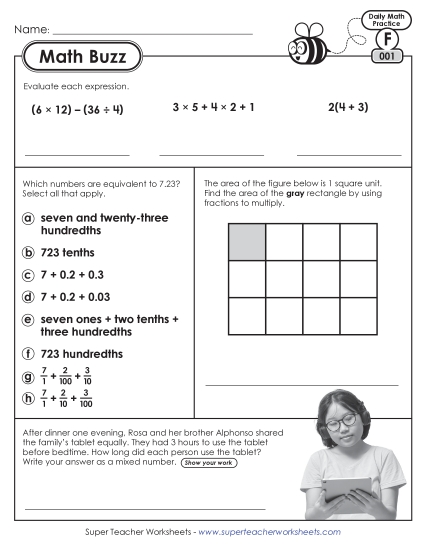
Use parentheses, brackets, or braces in numerical expressions, and evaluate expressions with these symbols.
5.NBT.3b:
Number And Operations In Base Ten
Understand The Place Value System.
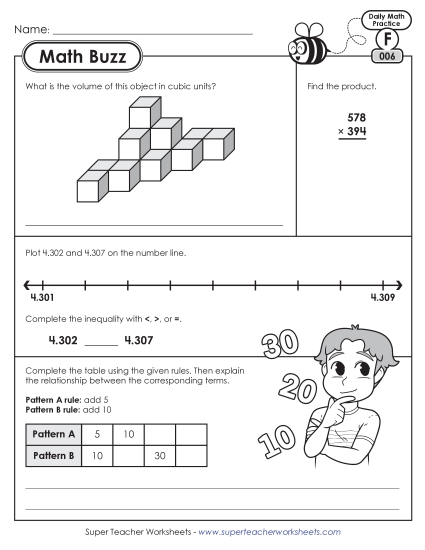
Compare two decimals to thousandths based on meanings of the digits in each place, using >, =, and < symbols to record the results of comparisons.
5.MD.3:
Measurement And Data
Geometric Measurement: Understand Concepts Of Volume And Relate Volume To Multiplication And To Addition.
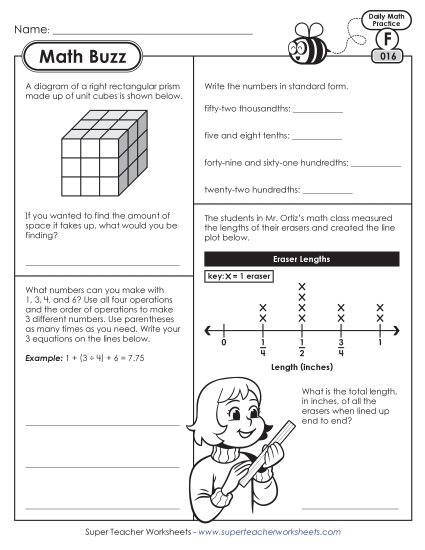
Recognize volume as an attribute of solid figures and understand concepts of volume measurement.
5.NF.4b:
Number And Operations - Fractions
Apply And Extend Previous Understandings Of Multiplication And Division To Multiply And Divide Fractions.
Find the area of a rectangle with fractional side lengths by tiling it with unit squares of the appropriate unit fraction side lengths, and show that the area is the same as would be found by multiplying the side lengths. Multiply fractional side lengths to find areas of rectangles, and represent fraction products as rectangular areas.
5.MD.4:
Measurement And Data
Geometric Measurement: Understand Concepts Of Volume And Relate Volume To Multiplication And To Addition.
Measure volumes by counting unit cubes, using cubic cm, cubic in, cubic ft, and improvised units.
5.G.1:
Geometry
Graph Points On The Coordinate Plane To Solve Real-World And Mathematical Problems.
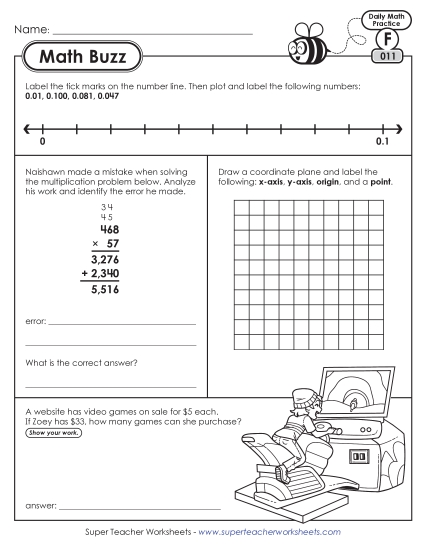
Use a pair of perpendicular number lines, called axes, to define a coordinate system, with the intersection of the lines (the origin) arranged to coincide with the 0 on each line and a given point in the plane located by using an ordered pair of numbers, called its coordinates. Understand that the first number indicates how far to travel from the origin in the direction of one axis, and the second number indicates how far to travel in the direction of the second axis, with the convention that the names of the two axes and the coordinates correspond (e.g., x-axis and x-coordinate, y-axis and y-coordinate).
5.NBT.5:
Number And Operations In Base Ten
Perform Operations With Multi-Digit Whole Numbers And With Decimals To Hundredths.
Fluently multiply multi-digit whole numbers using the standard algorithm.
5.NF.2:
Number And Operations - Fractions
Use Equivalent Fractions As A Strategy To Add And Subtract Fractions.
Solve word problems involving addition and subtraction of fractions referring to the same whole, including cases of unlike denominators, e.g., by using visual fraction models or equations to represent the problem. Use benchmark fractions and number sense of fractions
5.G.2:
Geometry
Graph Points On The Coordinate Plane To Solve Real-World And Mathematical Problems.
Represent real world and mathematical problems by graphing points in the first quadrant of the coordinate plane, and interpret coordinate values of points in the context of the situation.
5.MD.5a:
Measurement And Data
Geometric Measurement: Understand Concepts Of Volume And Relate Volume To Multiplication And To Addition.
Find the volume of a right rectangular prism with whole-number side lengths by packing it with unit cubes, and show that the volume is the same as would be found by multiplying the edge lengths, equivalently by multiplying the height by the area of the base. Represent threefold whole-number products as volumes, e.g., to represent the associative property of multiplication.

 Back
Back