Math
Reading Comprehension
Reading & Writing
Phonics
Early Literacy
Grammar
Spelling Lists
Science
Social Studies
Holidays
Puzzles & Brain Teasers
Teacher Helpers
Pre-K and Kindergarten
Worksheet Generator
Grade Levels
6th Grade Math Buzz Week 4:: Worksheets 16 through 20 Printable Daily Review PDF
This worksheet is recommended for students in Sixth Grade.
- Common Core Standards
5.NBT.35.NBT.15.NBT.54.OA.45.NF.15.NF.25.NF.35.OA.35.G.15.G.25.OA.15.OA.25.MD.3a5.MD.3b5.MD.45.MD.5a5.NF.4b5.MD.25.G.3
 Back
Back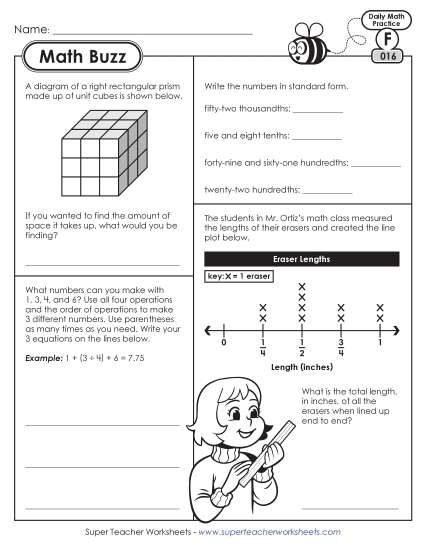

5.NBT.3:
Number And Operations In Base Ten
Understand The Place Value System.
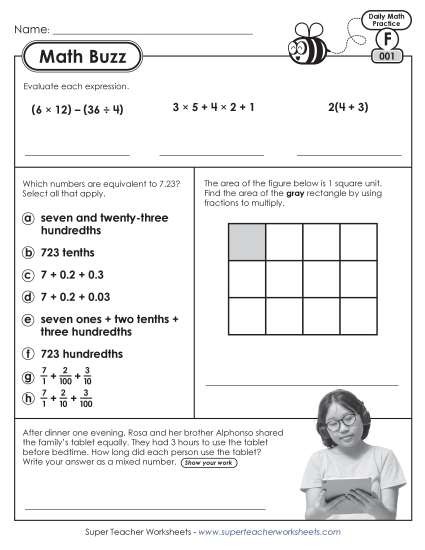
Read, write, and compare decimals to thousandths.
5.NBT.1:
Number And Operations In Base Ten
Understand The Place Value System.
Recognize that in a multi-digit number, a digit in one place represents 10 times as much as it represents in the place to its right and 1/10 of what it represents in the place to its left.
5.NBT.5:
Number And Operations In Base Ten
Perform Operations With Multi-Digit Whole Numbers And With Decimals To Hundredths.
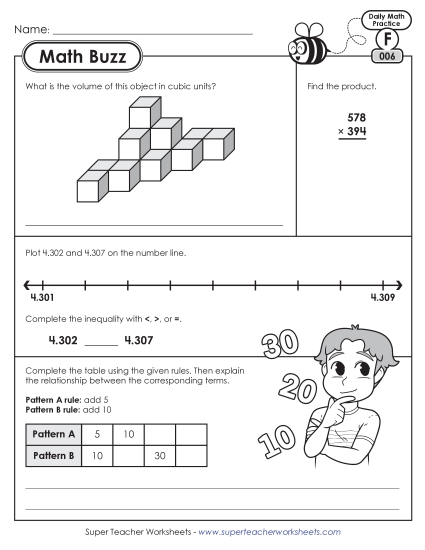
Fluently multiply multi-digit whole numbers using the standard algorithm.
4.OA.4:
Operations And Algebraic Thinking
Gain Familiarity With Factors And Multiples.
Find all factor pairs for a whole number in the range 1-100. Recognize that a whole number is a multiple of each of its factors. Determine whether a given whole number in the range 1-100 is a multiple of a given one-digit number. Determine whether a given whole number in the range 1-100 is prime or composite.
5.NF.1:
Number And Operations - Fractions
Use Equivalent Fractions As A Strategy To Add And Subtract Fractions.
Add and subtract fractions with unlike denominators (including mixed numbers) by replacing given fractions with equivalent fractions in such a way as to produce an equivalent sum or difference of fractions with like denominators. For example, 2/3 + 5/4 = 8/12 + 15/12 = 23/12. (In general, a/b + c/d = (ad + bc)/bd.)
5.NF.2:
Number And Operations - Fractions
Use Equivalent Fractions As A Strategy To Add And Subtract Fractions.
Solve word problems involving addition and subtraction of fractions referring to the same whole, including cases of unlike denominators, e.g., by using visual fraction models or equations to represent the problem. Use benchmark fractions and number sense of fractions
5.NF.3:
Number And Operations - Fractions
Apply And Extend Previous Understandings Of Multiplication And Division To Multiply And Divide Fractions.
Interpret a fraction as division of the numerator by the denominator (a/b = a / b). Solve word problems involving division of whole numbers leading to answers in the form of fractions or mixed numbers, e.g., by using visual fraction models or equations to represent the problem. For example, interpret 3/4 as the result of dividing 3 by 4, noting that 3/4 multiplied by 4 equals 3, and that when 3 wholes are shared equally among 4 people each person has a share of size 3/4. If 9 people want to share a 50-pound sack of rice equally by weight, how many pounds of rice should each person get? Between what two whole numbers does your answer lie?
5.OA.3:
Operations And Algebraic Thinking
Analyze Patterns And Relationships.
Generate two numerical patterns using two given rules. Identify apparent relationships between corresponding terms. Form ordered pairs consisting of corresponding terms from the two patterns, and graph the ordered pairs on a coordinate plane. For example, given the rule "Add 3" and the starting number 0, and given the rule "Add 6" and the starting number 0, generate terms in the resulting sequences, and observe that the terms in one sequence are twice the corresponding terms in the other sequence. Explain informally why this is so.
5.G.1:
Geometry
Graph Points On The Coordinate Plane To Solve Real-World And Mathematical Problems.
Use a pair of perpendicular number lines, called axes, to define a coordinate system, with the intersection of the lines (the origin) arranged to coincide with the 0 on each line and a given point in the plane located by using an ordered pair of numbers, called its coordinates. Understand that the first number indicates how far to travel from the origin in the direction of one axis, and the second number indicates how far to travel in the direction of the second axis, with the convention that the names of the two axes and the coordinates correspond (e.g., x-axis and x-coordinate, y-axis and y-coordinate).
5.G.2:
Geometry
Graph Points On The Coordinate Plane To Solve Real-World And Mathematical Problems.
Represent real world and mathematical problems by graphing points in the first quadrant of the coordinate plane, and interpret coordinate values of points in the context of the situation.
5.OA.1:
Operations And Algebraic Thinking
Write And Interpret Numerical Expressions.
Use parentheses, brackets, or braces in numerical expressions, and evaluate expressions with these symbols.
5.OA.2:
Operations And Algebraic Thinking
Write And Interpret Numerical Expressions.
Write simple expressions that record calculations with numbers, and interpret numerical expressions without evaluating them. For example, express the calculation "add 8 and 7, then multiply by 2" as 2 x (8 + 7). Recognize that 3 x (18932 + 921) is three times as large as 18932 + 921, without having to calculate the indicated sum or product.
5.MD.3a:
Measurement And Data
Geometric Measurement: Understand Concepts Of Volume And Relate Volume To Multiplication And To Addition.
A cube with side length 1 unit, called a "unit cube," is said to have "one cubic unit" of volume, and can be used to measure volume.
5.MD.3b:
Measurement And Data
Geometric Measurement: Understand Concepts Of Volume And Relate Volume To Multiplication And To Addition.
A solid figure which can be packed without gaps or overlaps using n unit cubes is said to have a volume of n cubic units.
5.MD.4:
Measurement And Data
Geometric Measurement: Understand Concepts Of Volume And Relate Volume To Multiplication And To Addition.
Measure volumes by counting unit cubes, using cubic cm, cubic in, cubic ft, and improvised units.
5.MD.5a:
Measurement And Data
Geometric Measurement: Understand Concepts Of Volume And Relate Volume To Multiplication And To Addition.
Find the volume of a right rectangular prism with whole-number side lengths by packing it with unit cubes, and show that the volume is the same as would be found by multiplying the edge lengths, equivalently by multiplying the height by the area of the base. Represent threefold whole-number products as volumes, e.g., to represent the associative property of multiplication.
5.NF.4b:
Number And Operations - Fractions
Apply And Extend Previous Understandings Of Multiplication And Division To Multiply And Divide Fractions.
Find the area of a rectangle with fractional side lengths by tiling it with unit squares of the appropriate unit fraction side lengths, and show that the area is the same as would be found by multiplying the side lengths. Multiply fractional side lengths to find areas of rectangles, and represent fraction products as rectangular areas.
5.MD.2:
Measurement And Data
Represent And Interpret Data.
Make a line plot to display a data set of measurements in fractions of a unit (1/2, 1/4, 1/8). Use operations on fractions for this grade to solve problems involving information presented in line plots. For example, given different measurements of liquid in identical beakers, find the amount of liquid each beaker would contain if the total amount in all the beakers were redistributed equally.
5.G.3:
Geometry
Classify Two-Dimensional Figures Into Categories Based On Their Properties.
Understand that attributes belonging to a category of two- dimensional figures also belong to all subcategories of that category. For example, all rectangles have four right angles and squares are rectangles, so all squares have four right angles.