RI.6.1:
Reading Informational
Key Ideas and Details
Cite textual evidence to support analysis of what the text says explicitly as well as inferences drawn from the text.
RI.6.4:
Reading Informational
Craft and Structure
Determine the meaning of words and phrases as they are used in a text, including figurative, connotative, and technical meanings.
RI.6.5:
Reading Informational
Craft and Structure
Analyze how a particular sentence, paragraph, chapter, or section fits into the overall structure of a text and contributes to the development of the ideas.
RI.6.6:
Reading Informational
Craft and Structure
Determine an author's point of view or purpose in a text and explain how it is conveyed in the text.
L.6.1:
Language
Conventions of Standard English
Demonstrate command of the conventions of standard English grammar and usage when writing or speaking.
L.6.1b:
Language
Conventions of Standard English
Use intensive pronouns (e.g., myself, ourselves).
L.6.1c:
Language
Conventions of Standard English
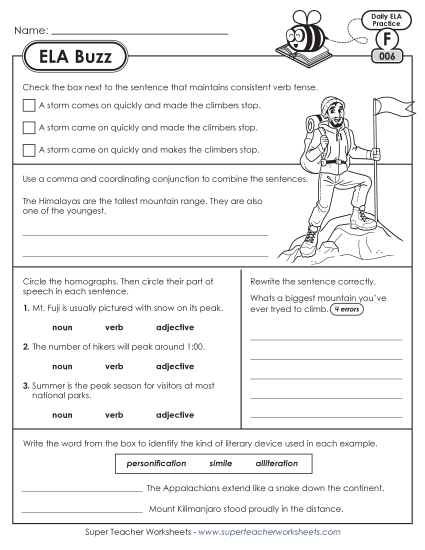
Recognize and correct inappropriate shifts in pronoun number and person.
L.6.2:
Language
Conventions of Standard English
Demonstrate command of the conventions of standard English capitalization, punctuation, and spelling when writing.
L.6.2a:
Language
Conventions of Standard English
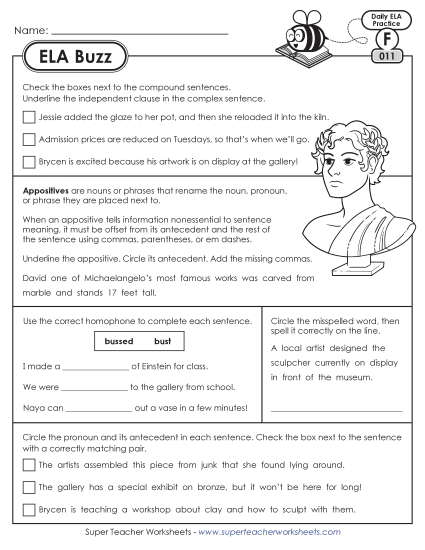
Use punctuation (commas, parentheses, dashes) to set off nonrestrictive/parenthetical elements.
L.6.2b:
Language
Conventions of Standard English
Spell correctly.
L.6.3a:
Language
Knowledge of Language
Vary sentence patterns for meaning, reader/ listener interest, and style.
L.6.4:
Language
Vocabulary Acquisition and Use
Determine or clarify the meaning of unknown and multiple-meaning words and phrases based on grade 6 reading and content, choosing flexibly from a range of strategies.
L.6.4a:
Language
Vocabulary Acquisition and Use
Use context (e.g., the overall meaning of a sentence or paragraph; a word’s position or function in a sentence) as a clue to the meaning of a word or phrase.
L.6.4b:
Language
Vocabulary Acquisition and Use
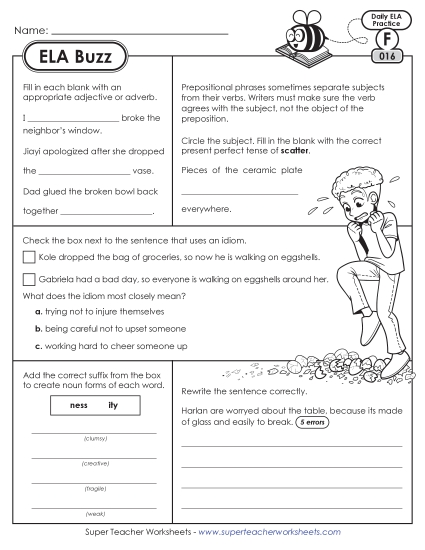
Use common, grade-appropriate Greek or Latin affixes and roots as clues to the meaning of a word (e.g., audience, auditory, audible).
L.6.5:
Language
Vocabulary Acquisition and Use
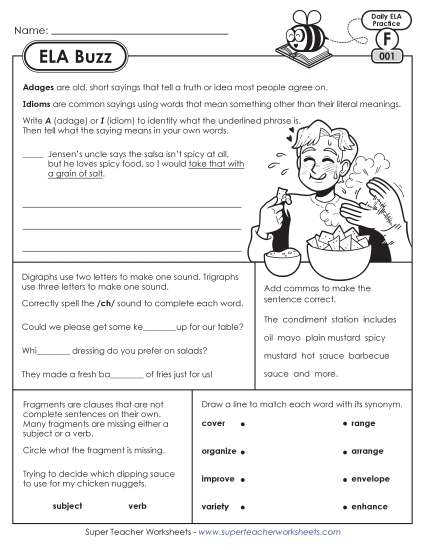
Demonstrate understanding of figurative language, word relationships, and nuances in word meanings.
L.6.5a:
Language
Vocabulary Acquisition and Use
Interpret figures of speech (e.g., personification) in context.
L.6.5b:
Language
Vocabulary Acquisition and Use
Use the relationship between particular words (e.g., cause/effect, part/whole, item/category) to better understand each of the words.
L.6.5c:
Language
Vocabulary Acquisition and Use
Distinguish among the connotations (associations) of words with similar denotations (definitions) (e.g., stingy, scrimping, economical, unwasteful, thrifty).
W.6.4:
Writing
Production and Distribution of Writing
Produce clear and coherent writing in which the development, organization, and style are appropriate to task, purpose, and audience. (Grade-specific expectations for writing types are defined in standards 1-3 above.)

 Back
Back