Math
Reading Comprehension
Reading & Writing
Phonics
Early Literacy
Grammar
Spelling Lists
Science
Social Studies
Puzzles & Brain Teasers
Teacher Helpers
Pre-K and Kindergarten
Worksheet Generator
Grade Levels
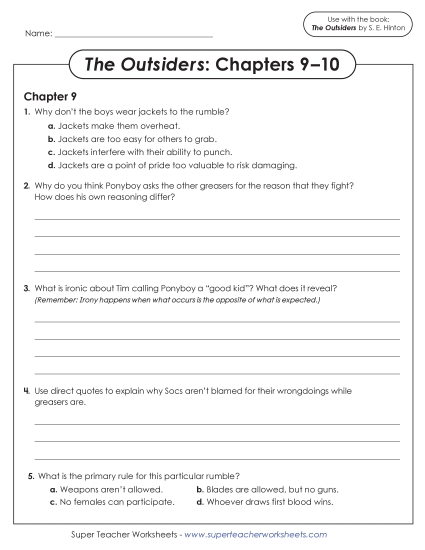
Questions for Chapters 9–10 Printable Book The Outsiders 9 10 PDF Worksheet
This worksheet is recommended for students in Seventh Grade, Eighth Grade, Ninth Grade, and Tenth Grade.
- Common Core Standards
RL.7.1RL.7.2RL.7.3RL.7.4RL.7.10W.7.4L.7.5RL.8.1RL.8.2RL.8.3RL.8.4RL.8.10W.8.4L.8.5RL.9-10.1RL.9-10.2RL.9-10.3RL.9-10.4RL.9-10.10W.9-10.4L.9-10.5
 Back

RL.7.1:
Reading Literature
Key Ideas and Details
Cite several pieces of textual evidence to support analysis of what the text says explicitly as well as inferences drawn from the text.
RL.7.2:
Reading Literature
Key Ideas and Details
Determine a theme or central idea of a text and analyze its development over the course of the text; provide an objective summary of the text.
RL.7.3:
Reading Literature
Key Ideas and Details
Analyze how particular elements of a story or drama interact (e.g., how setting shapes the characters or plot).
RL.7.4:
Reading Literature
Craft and Structure
Determine the meaning of words and phrases as they are used in a text, including figurative and connotative meanings; analyze the impact of rhymes and other repetitions of sounds (e.g., alliteration) on a specific verse or stanza of a poem or section of a story or drama.
RL.7.10:
Reading Literature
Range of Reading and Level of Text Complexity
By the end of the year, read and comprehend literature, including stories, dramas, and poems, in the grades 6-8 text complexity band proficiently, with scaffolding as needed at the high end of the range.
W.7.4:
Writing
Production and Distribution of Writing
Produce clear and coherent writing in which the development, organization, and style are appropriate to task, purpose, and audience. (Grade-specific expectations for writing types are defined in standards 1-3 above.)
L.7.5:
Language
Vocabulary Acquisition and Use
Demonstrate understanding of figurative language, word relationships, and nuances in word meanings.
RL.8.1:
Reading Literature
Key Ideas and Details
Cite the textual evidence that most strongly supports an analysis of what the text says explicitly as well as inferences drawn from the text.
RL.8.2:
Reading Literature
Key Ideas and Details
Determine a theme or central idea of a text and analyze its development over the course of the text, including its relationship to the characters, setting, and plot; provide an objective summary of the text.
RL.8.3:
Reading Literature
Key Ideas and Details
Analyze how particular lines of dialogue or incidents in a story or drama propel the action, reveal aspects of a character, or provoke a decision.
RL.8.4:
Reading Literature
Craft and Structure
Determine the meaning of words and phrases as they are used in a text, including figurative and connotative meanings; analyze the impact of specific word choices on meaning and tone, including analogies or allusions to other texts.
RL.8.10:
Reading Literature
Range of Reading and Level of Text Complexity
By the end of the year, read and comprehend literature, including stories, dramas, and poems, at the high end of grades 6-8 text complexity band independently and proficiently.
W.8.4:
Writing
Production and Distribution of Writing
Produce clear and coherent writing in which the development, organization, and style are appropriate to task, purpose, and audience. (Grade-specific expectations for writing types are defined in standards 1-3 above.)
L.8.5:
Language
Vocabulary Acquisition and Use
Demonstrate understanding of figurative language, word relationships, and nuances in word meanings.
RL.9-10.1:
Reading Literature
Key Ideas and Details
Cite strong and thorough textual evidence to support analysis of what the text says explicitly as well as inferences drawn from the text.
RL.9-10.2:
Reading Literature
Key Ideas and Details
Determine a theme or central idea of a text and analyze in detail its development over the course of the text, including how it emerges and is shaped and refined by specific details; provide an objective summary of the text.
RL.9-10.3:
Reading Literature
Key Ideas and Details
Analyze how complex characters (e.g., those with multiple or conflicting motivations) develop over the course of a text, interact with other characters, and advance the plot or develop the theme.
RL.9-10.4:
Reading Literature
Craft and Structure
Determine the meaning of words and phrases as they are used in the text, including figurative and connotative meanings; analyze the cumulative impact of specific word choices on meaning and tone (e.g., how the language evokes a sense of time and place; how it sets a formal or informal tone).
RL.9-10.10:
Reading Literature
Range of Reading and Level of Text Complexity
By the end of grade 9, read and comprehend literature, including stories, dramas, and poems, in the grades 9-10 text complexity band proficiently, with scaffolding as needed at the high end of the range.
W.9-10.4:
Writing
Production and Distribution of Writing
Produce clear and coherent writing in which the development, organization, and style are appropriate to task, purpose, and audience. (Grade-specific expectations for writing types are defined in standards 1-3 above.)
L.9-10.5:
Language
Vocabulary Acquisition and Use
Demonstrate understanding of figurative language, word relationships, and nuances in word meanings.